Why production capacity sets the ceiling on marketing performance (especially in the age of AI)


I have settled a lot.
As a product marketer and campaign leader, I’ve shipped one generic sales deck when three variations were needed. One email when the audience deserved six. One one-pager written to work for a CIO and a practitioner at the same time, which means it worked for neither.
I could describe the better versions out loud. I just couldn’t get them built in time.
Some of that was my own time and headspace. Most of it wasn’t. It was the time of the people I depended on — creative, digital, marketing ops — the ones who turned ideas and rough drafts into something we could actually launch and track. Every extra version I wanted was a favour I was asking of somebody whose queue was already full.
So I’d look at the launch date, look at my queue, and cut. Not the idea. The variants. The specificity. The exact thing that would have made it land for a specific audience.
I don’t think I’m unusual. This is the quiet, daily compromise of enterprise marketing, especially in B2B. No one wants to be generic. But when production is a constraint, we settle for the asset that meets the deadline instead of pushing for the one(s) that will accomplish the objective.
What production (or lack thereof) is costing you today
If you work outside the MOps bubble, you probably haven’t spent much time thinking about the time and energy that goes into making an asset “launch ready.” In the past few weeks I’ve learned this: a single enterprise email tends to cost the time of four or more people. It involves three to five separate tools and two to three rounds of revisions. All-in, an email costs somewhere between $300 and $2,400 in internal labour before it ever leaves the building. That’s from our own research with 333 enterprise marketing decision-makers, and when we show that math to enterprise marketing ops leaders they don’t argue with it. Sometimes they tell us it’s low.
Now take a campaign that genuinely deserves twelve versions. Enterprise, mid-market and SMB. Three verticals. Four languages. Do the multiplication and you’re looking at several thousand dollars in production labour and weeks of other people’s calendars, for one campaign.
Nobody signs off on that.
So you build one. You drop a merge tag into the greeting so it says the person’s first name. And you call it personalized.
But that’s not personalization. That’s addressing.
“Hi {{first_name}}” isn’t personalization. It’s a receipt for a production problem.
And every one of us knows that personalization drives performance. McKinsey puts the revenue lift from personalization somewhere between 10 and 15 percent. We all believe it. So what’s stopped us from doing something about it? Capacity.
Capacity caps how many variants you can build. Variants cap how much you can personalize and test. Personalization and testing cap conversion. Conversion caps pipeline. In short, production capacity is the ceiling on your marketing performance.
AI made everyone a creator. It didn’t make anyone a producer.
You’d think the last two years would have fixed this. Drafts are free now. Everyone has a copywriter, a strategist, and a junior designer in a browser tab.
But think about where that capability actually landed. More than 80 percent of marketers now use AI to create content. Only about a quarter use it to build or ship the asset itself.
That pairing is the whole problem in two numbers. We poured two years of investment into the side of the process that was never the bottleneck.
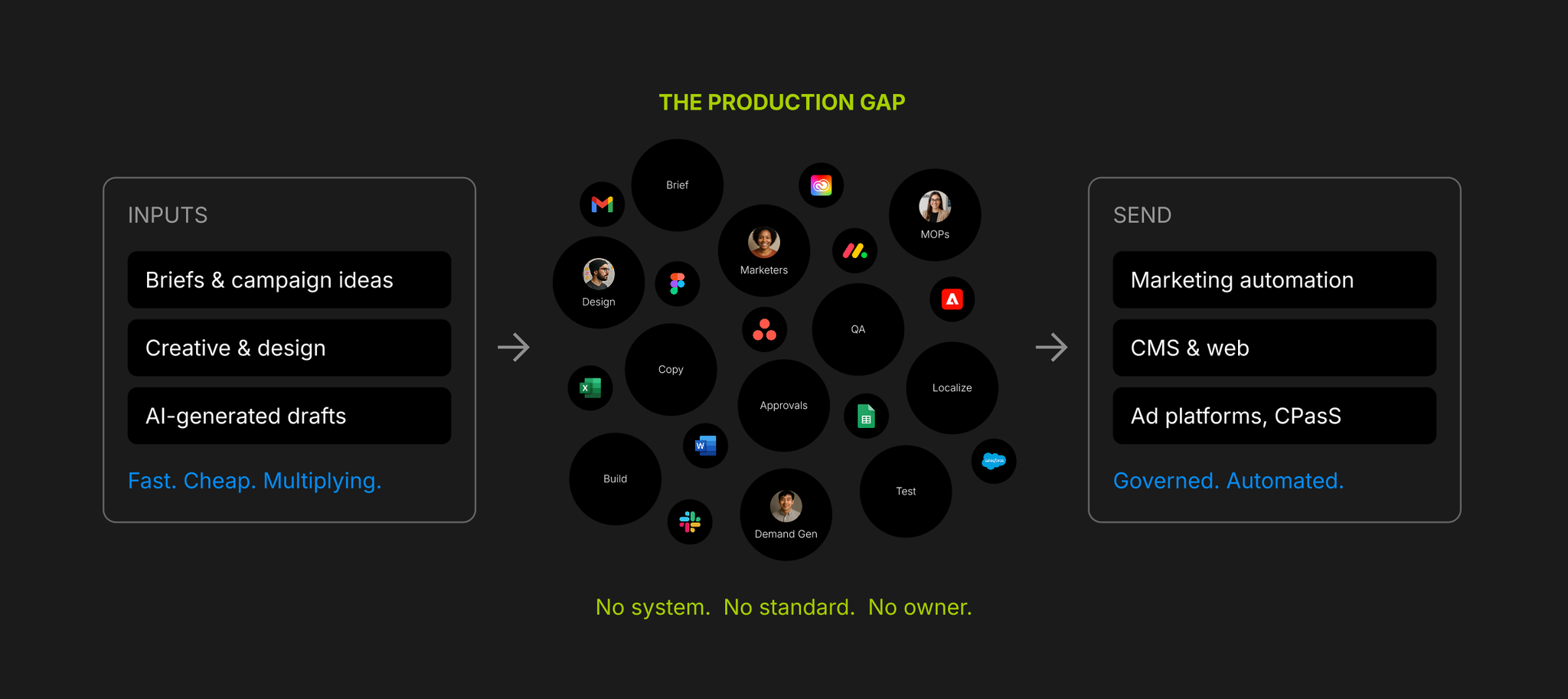
Because the bottleneck isn’t ideas or even content. With GenAI you have more than you’ve ever had. And no one’s struggling with ‘send.’ Your MAP, your ad platforms, your CPaaS: they work. In fact they’re probably working well under capacity.
What’s slow is everything in the middle. Turning raw ideas and creative into launch-ready assets. The building, the rendering, the brand checks, the approvals, the rebuilds that follow the approvals.
And here’s what makes this middle layer messy: it has no system. You have systems for content creation and send. Production runs on tickets, Slack threads, and whoever on the team happens to be good at it. No standard, no owner, no line item.
AI didn’t touch that middle. It just made the left side bigger. Faster input into a clogged drain isn’t speed. It’s pressure — and 82 percent of enterprise teams now spend half their week or more on production work instead of strategy.
What happens when the ceiling lifts
I’ve seen the story play out differently.
WordPress VIP had one email template. Every send looked the same regardless of what was in it, because there was no affordable way to make it look like anything else. When production stopped being the constraint, the emails stopped being identical — and click-through went up 120 percent.
Forbes had been running campaigns against generic landing pages owned by the web team, because campaign-specific pages meant developer time nobody had. Once the campaign team could build the pages themselves, landing page conversion doubled.
Citrix went from five people who could build an email to eighty, in a matter of weeks. What I find telling is what their marketing ops lead said about it: “I could actually sleep at night.” That’s not a throughput metric. That’s what it feels like when you stop being the queue.
These teams raised their production capacity, and the performance that had been trapped underneath it came out.
What the middle actually needs
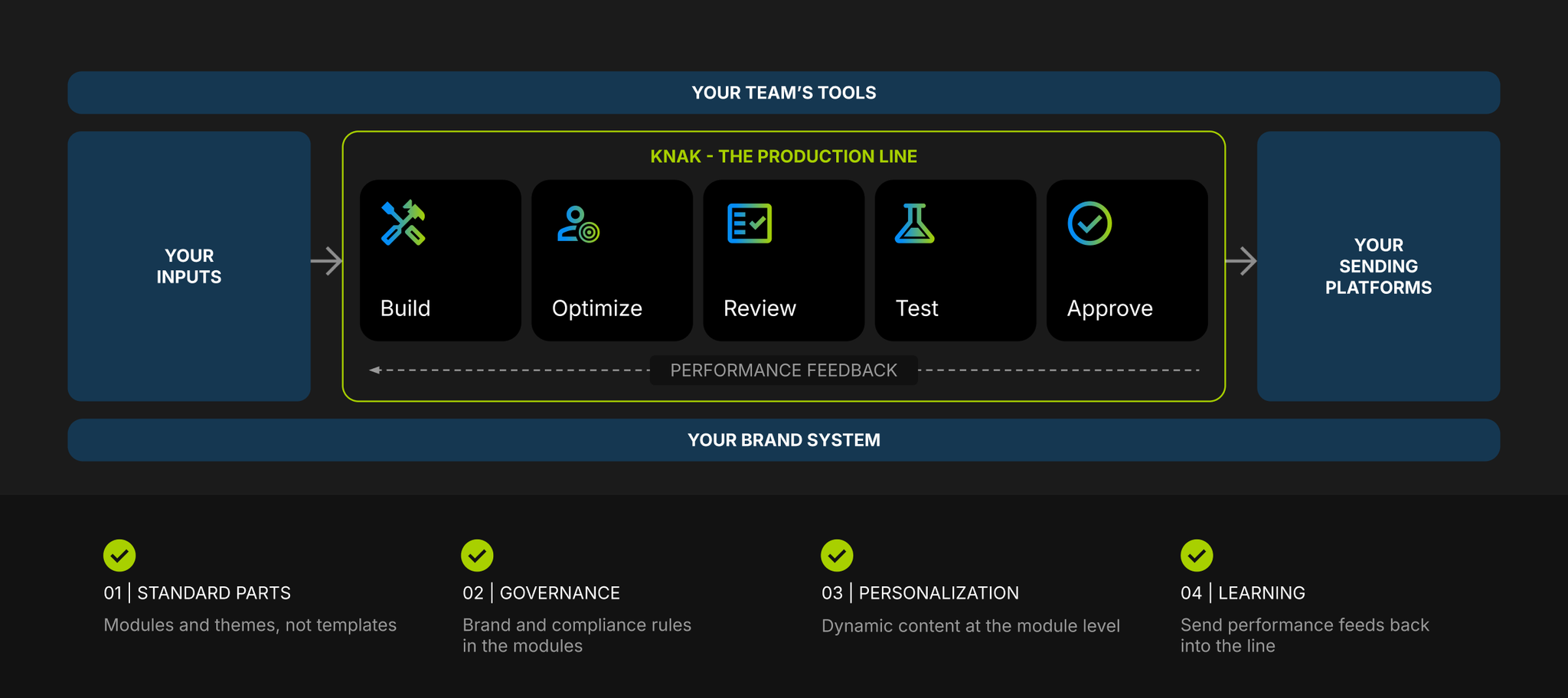
If you accept that production is a system problem, then the answer isn’t more people or another point tool. It’s a better production system. A few months ago we heard a customer describe Knak as a “flexible factory.” That really clicked and we’ve been running with the metaphor to describe how the ideal marketing production system should work.
One note on the metaphor here, because the wrong version throws people off. Ford gets the credit for the assembly line, and Ford’s line killed variety (any colour you like, as long as it’s black). Clearly, that’s not what we’re after. What we want is a system that enables humans and AI to work collaboratively to produce truly creative and impactful content, personalized, at scale, with brand and compliance guardrails baked in.
That’s closer to Toyota’s mixed-model production line: different (but standardized) parts, different configurations, same line.
There’s an obvious objection here, and it’s worth taking seriously. Marketing isn’t manufacturing. Nobody got into this work to run a line.
But look at where craft actually goes right now. A designer with fifteen years of taste, resizing a hero image for the fourth region. A copywriter who can find the one true sentence, retyping a legal disclaimer into variant nine. That’s not craft. That’s labor that happens to be done by skilled people.
A production system doesn’t remove the craft. It moves it. The judgment goes into the parts — how this module holds a long headline and a short one, what the spacing does to the eye, where the brand can flex and where it can’t. Get that right once and it shows up in every asset built from it. Craft compounds instead of evaporating.
Then the argument in the room changes. Not “can we build this in time,” but “is this the right thing to say?” That’s the conversation you hired those people for.
So what does a flexible marketing factory actually need to deliver speed, scale, and consistency without giving up the craft?
Crafted parts, built to standard. Modular components instead of whole templates; a parts bin, not a shelf of finished cars. This is the place in the system that deserves your best people. Not to make the emails, to make the parts every email gets built from.
Governance inside the parts. Brand and compliance rules living in the components themselves, so anyone (a field marketer, a new hire, an agent) can build without the ability to break anything. This is the one that unlocks the rest, and it’s the one most teams get backwards. You don’t approve forty emails. You approve the parts once, then assemble forty.
Personalization at the module level. Dynamic content inside the blocks, so you’re varying the visual and the value proposition for a segment, not just the name in a merge tag at the top.
A line that improves with use. Performance data from your sending platform flowing back into the components, so the module that worked last quarter is the one sitting in front of you this quarter.
Knak customers build emails this way. No company that I know of has a production process like this to produce assets for other channels: mobile messages, push, display ads, social. For the most part, they’re building bespoke. It’s costing them time, efficiency, and most importantly, performance.
The questions worth asking your team
You don’t need a maturity assessment to find out where you stand. One question does it, at your next planning session:
If you could run every campaign three different ways — three audiences, three angles, three tests — with no extra tickets, no favours, no calendar negotiation with three departments for approval, what would you do next quarter that you’re not doing today?
Whatever people say next is the performance your production capacity has been quietly holding back. Not your strategy. Not your creative. Not your budget.