
Almost three years ago to the day, I was in Menlo Park for an event we held at the Meta campus... and not one speaker mentioned AI.
On October 29, 2026, I was back in Menlo Park for The Agentic Marketing Forum at Snowflake's Silicon Valley AI Hub. So much AI! So much so that when a panelist got asked how many people report to her, she goes... "humans or agents?" 😂
We've completely 180'd.
That said, as impressive as the speakers were, nobody on stage pretended to have it all figured out. Not OpenAI, not NVIDIA, not Meta, not Snowflake, not CrowdStrike. Jeff Canada from OpenAI said it plainly about the context his agents run on: "I haven't solved it yet." So if you're feeling behind... you're really not.
Almost everyone has gotten personally faster with AI. A prompt here, a custom GPT there. The companies furthest ahead are building something bigger. The CrowdStrike team made the point directly. It's great that everyone in marketing is running their own prompts, but to actually streamline how the team works, they have to move to shared workflows.
So here's what some of the biggest companies in the world are actually recommending.
The short version:
- Snowflake: pick a few AI pillars, and use them to say no.
- OpenAI and NVIDIA: find a toehold, one reliable first block. For most teams, that's intake.
- CrowdStrike: let agents earn autonomy, based on what happens if they get it wrong.
- Meta: use AI where there's judgment, and plain automation where there's one right answer.
- NVIDIA: only build what you want your team obsessing over.
- The panel: the skill that matters most is systems thinking.
1. Snowflake: pick your pillars
Hillary Carpio opened a session about AI by saying "efficiency is not very motivating across the org."
Her team had plenty of AI. The problem was that most of it lived on individual laptops and never got shared. As she put it, "I can't tell you how many skills we have for building slides, but we need a single slide-building skill."
So they asked a different question. How do you make sure your data, engineering and ops effort adds up to changing how the whole team works, and not just to making a few people faster?
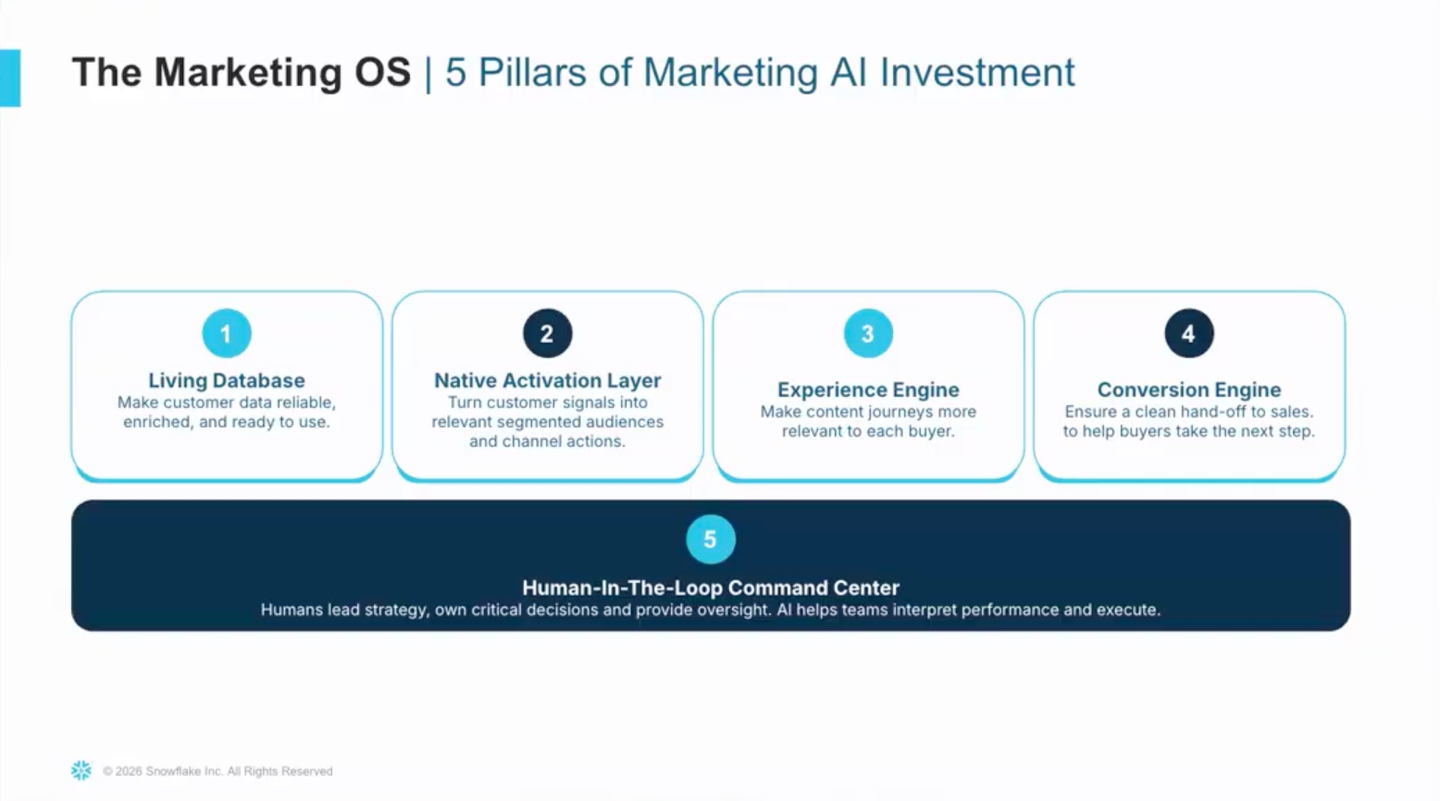
Their answer was five pillars of marketing AI investment, in the order they depend on each other:
- A living database. This comes first because nothing else works without it. "If your data is not correct, all of the rest won't matter… You're automating sloppy." (Or as one of their sales leaders put it: "You just do worse things faster if you have bad data.")
- A native activation layer. Turn customer signals into audiences and channel actions straight from the data, instead of copying it into every vendor and cleaning up the mess.
- An experience engine. Make every buyer's journey more relevant to them. They haven't solved this one yet, and it's on the list on purpose, so it keeps pulling their priorities in that direction.
- A conversion engine. A clean hand-off to sales, and an answer to "why didn't this lead MQL?" before anyone has to ask.
- A human-in-the-loop command center. One place where people make the decisions and AI helps them read performance and act, so everyone works from the same context.
They use the pillars as a filter. A request came in, and "there was no pillar for it." Hillary's reaction: "maybe that's not the most important thing we should be focusing on."
What two of the pillars look like in practice
Next best offer (pillar 3). Snowflake used to run 10 to 15 nurture streams, split by persona and industry, and keeping the content fresh took "a gargantuan amount of effort." Next best offer replaces those streams with a model that picks the next offer for each person. It looks at two things. The first is the person: their past score, which formats they engage with (are they more of an e-book or a webinar person?), where they are, and what comes up in their sales call transcripts. The second is the content: its type, topic, funnel stage and what has worked before. A data team that reports into marketing built it with a partner for the model, with no help needed from central engineering.
Early results show MQL conversion at 5x their traditional nurture. Vivian Cheng was clear that this is a small-scale pilot covering one stage of the journey. The snag they hit was the content tags. People had tagged content inconsistently, some prioritizing industry and others persona, so the team had to agree on how they tag before the model could work.
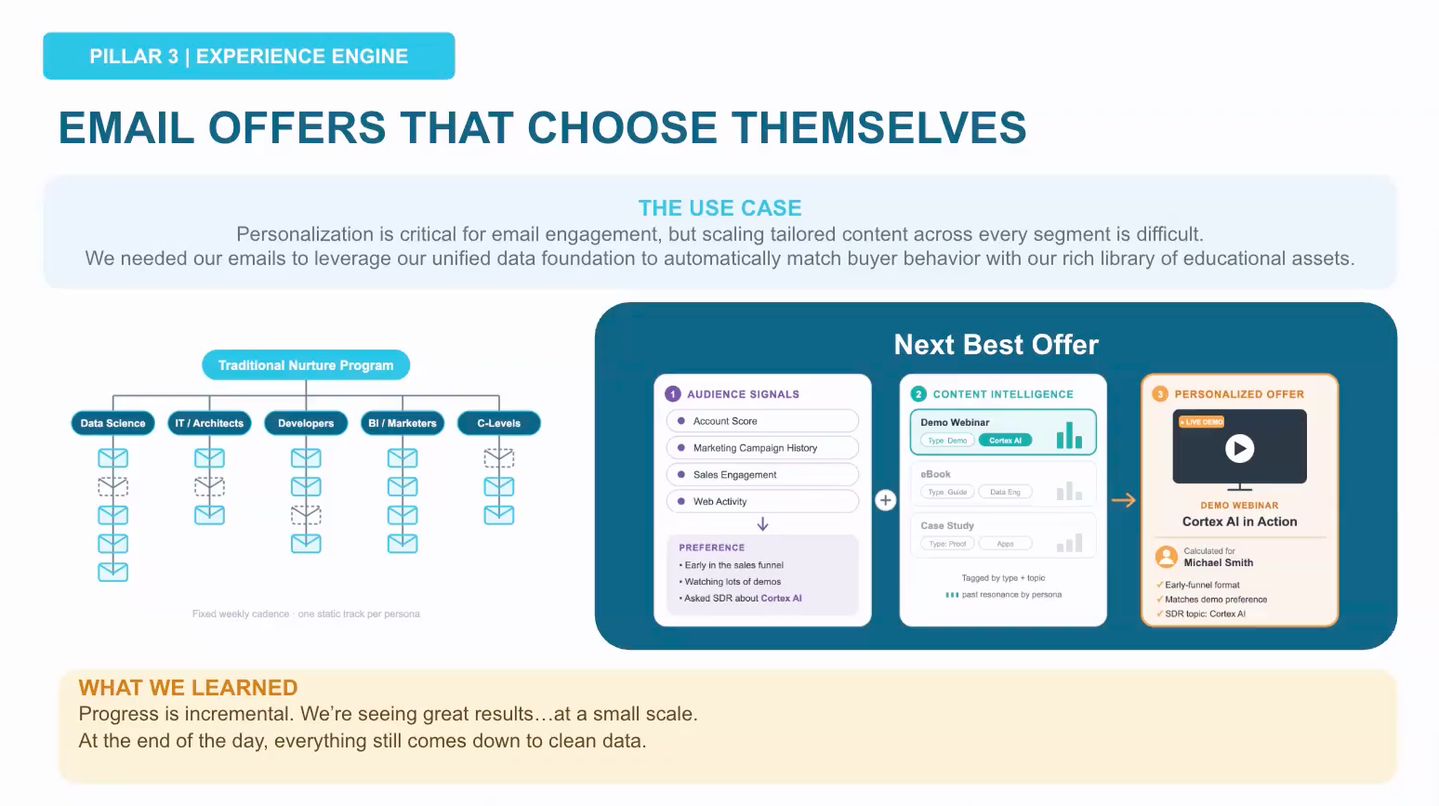
It's also a good example of what Jon Miller thinks the industry is under-investing in. In his view, most AI personalisation today goes into rewriting the message for each person, like AI SDR emails that open with a line about someone's college sports team. He called that a fancier form of AI slop. The bigger opportunity is using agents to get the right offer to the right people at the right time, which most teams still do with rules and smart lists. His analogy was a playlist. Everyone gets a different mix, built from great songs that already exist, and nobody needs a song written just for them. That's what Snowflake's next best offer is doing today.
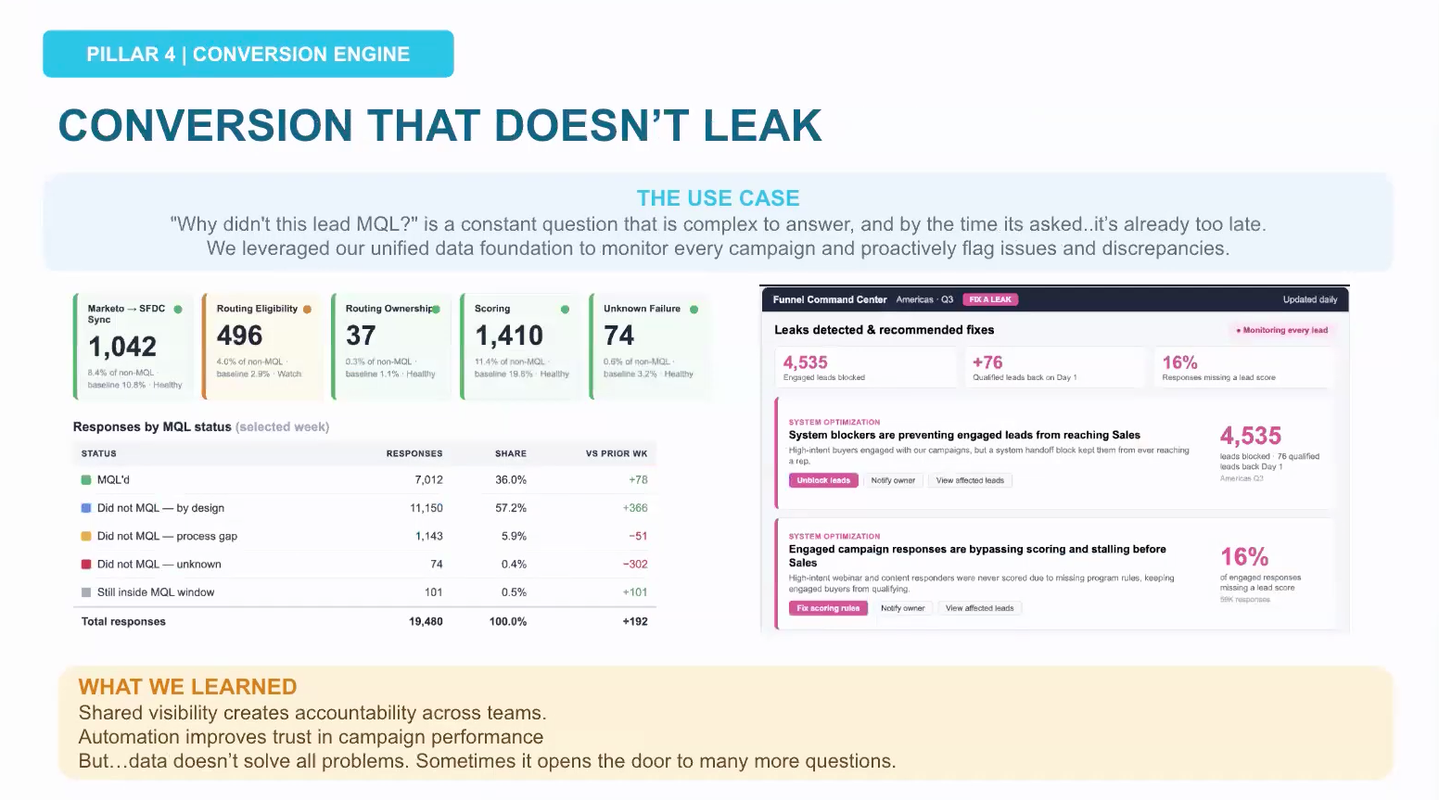
Conversion that doesn't leak (pillar 4). Leads leak between marketing and sales all the time. A routing rule breaks, a campaign response skips scoring, someone leaves and their leads never get reassigned. Usually nobody finds out until a marketer or a leader asks why a lead never reached sales, and as Vivian put it, "by the time somebody is asking you this question, it's generally too late." On the panel earlier, Hillary said chasing those leaks "was my full-time job for at least 6 months… I do not want to go back."
So they built a monitor that watches every campaign and every step a lead passes through, across Marketo, Salesforce and their lead data. It updates daily and tracks the places leads usually leak: the Marketo-to-Salesforce sync, routing eligibility, routing ownership and scoring. When something leaks, it gets flagged with a recommended fix before anyone else notices. Their slide showed two examples. One read "System blockers are preventing engaged leads from reaching Sales," with buttons to unblock the leads or notify the owner. The other read "Engaged campaign responses are bypassing scoring and stalling before Sales," because webinar and content responders had never been scored due to missing program rules. Every lead that doesn't MQL also gets a reason (by design, needs a process fix, or needs investigating), so ops has the answer before the question comes in.
In one case, three SDR managers left and their leads were never reassigned. By the time anyone noticed, weeks had passed. Their takeaway was that "shared visibility creates accountability across teams." Seeing every "didn't MQL by design" lead also made them question business rules they'd had for years. As Vivian said, "data doesn't solve all problems. Sometimes it opens the door to more questions."
I think every company should have a few AI pillars like these, agreed at the leadership level and used to decide what gets built. They also give your team an easy "no." And Hillary was clear it doesn't have to look like hers: "Yours could look very different."
If you're in marketing ops, this is yours to lead. You already know what's been built, where the data lives and which requests keep coming back. That's everything you need to set the pillars. And once they exist, every new AI idea gets checked against them... by you.
Try it:
- Write down every AI thing your team has built this year.
- Group them.
- Name the 3–5 outcomes they should add up to, in the order they depend on each other. Data probably goes first.
- Say no to anything without a pillar.
2. OpenAI and NVIDIA: find a toehold
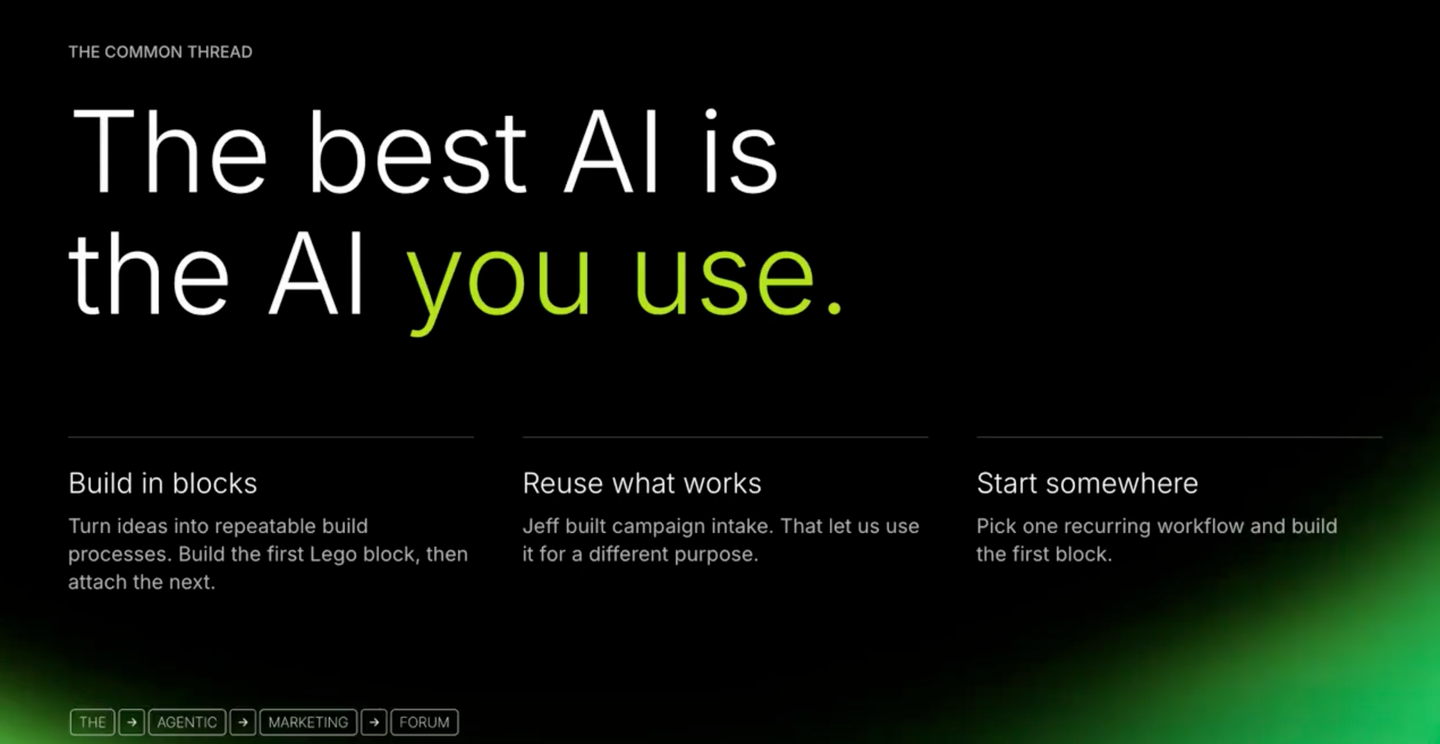
Jeff Canada's first win at OpenAI wasn't a clever agent. It was intake. His intake form flopped, because people wanted to ask for things in Slack. So he let them, and had AI turn those Slack messages into structured tasks. He spent months on that before any agent did real work.
"It wasn't the sexiest thing… AI was taking a Slack message and putting it into a project management tool. And that created space and time for me to start to build what's next."
James Finlay from NVIDIA put it to the room as the one thing to take away: "find a toehold." The hard part is finding the first thing that's good enough to rely on. Once you have it, he said, "I can go left, I can go right, I can go up, I can go down."
How the first block works. A requester says "I want to send an email" and gets asked for a campaign brief. An agent reads the brief and checks it has what an email needs: subject line, header, design, components. If something's missing, like alt text, it goes back to the requester. Jeff spent around six months on "get a request, tell me what to do with it" before adding agents on top. Today, a Slack channel kicks off a set of agents that build the emails and the audiences, and a human does the final check and clicks send.
How the next block works. James built a growth testing engine on top of this at OpenAI, before he joined NVIDIA. Going from test idea to live test used to take about three weeks. He set it up in stages in Linear, their project management tool:
- A Slack request becomes structured data. The agent checks it's complete and pings the requester if it isn't.
- The audience gets defined and rough content gets drafted, and the A/B test is staged.
- The agent checks for conflicts with tests already running, then deploys.
- It monitors the live test. If one version is getting half the volume of the other, something's wrong.
Moving a card to the next status in Linear is what triggers the agent for that stage. That gives every agent a clear start and stop, so each one knows its job and when it's done. A person approves every stage. When results come in, Codex reads them and recommends whether to ship, stop or test something new. Codex can recommend stopping a test, but it can't stop one.
Their best case was 3.5 hours from idea to live test, though James said the average is "probably not three and a half hours."
Three other companies are working on the same first block:
- CrowdStrike is building one front door for requests. A marketer describes what they need in Slack, and an agent works out the request type, creates the Workfront ticket, routes it to the MOps queue and tells the requester, in seconds and with no rigid templates. It's launching soon, starting with the requests ops owns.
- Meta traced its six-week campaign builds back to handoffs across 6+ teams.
- Snowflake is replacing the email ticket with a command center. Hillary's framing: "instead of making that faster and better, how do we fundamentally change it?"
Try it: pick the one recurring request your team gets the most, and build the first block there. As the slide said: "Start somewhere."
3. CrowdStrike: let agents earn their autonomy
CrowdStrike puts a human on anything a customer will see. "As a brand, we will not send out anything without a human in the loop."
So they decide how much autonomy each task gets. Every agent task sits on one of three tiers:
Tier | Who does what | Example |
|---|---|---|
Human only | "The agent prepares and a person decides" | Launch approvals, sends to customers, audience changes at scale |
Agent works, human reviews | The agent does it, a person checks it | List imports, Marketo programs |
AI runs, human spot-checks | The agent acts on its own | Answering questions in Slack |
They set the tier with three questions:
- Can we undo it? Importing a list is recoverable. Sending an email isn't.
- How far can the mistake spread? One record, or the whole database?
- Who sees the result? A customer, or a prospect?
"The riskiest answer sets the tier, and that can move up and down" as the agent proves itself. To get there, they start small, add checkpoints, learn from the results, and then move to workflows.
Tier 2 in practice: list imports. List imports are their highest-volume request, more than 100 a month. Each one used to take two hours. Someone had to scrub the list, chase missing required fields and UTMs, go back and forth with the requester, create and activate the Marketo program, then import.
Now the agent gets the list, the Salesforce campaign name and ID, and a set of prompts with guardrails. It cleans and validates the list, creates the Marketo program, checks and activates the triggers, and imports. A person then checks that the imported counts match the source list and signs off before anything goes live. It takes 30 minutes, and the team can run several at once.
Check whose permissions your AI is using. Kyle McCormick walked through a scenario. An engineer who has never heard of Marketo asks Claude to send an email to engineers. Claude finds a Marketo MCP. Engineers are in CrowdStrike's ICP, so the database is full of them. Claude builds the email, it contains confidential information, and it goes out to customers.
The engineer would never have had permission to send that email in Marketo. The AI did, because of how it was connected. Some connections (MCPs) make you log in as yourself, so the AI can only do what you're allowed to do. Others run through a shared API user an admin set up, so anyone using the AI gets that user's access, which is often admin. CrowdStrike wants their Marketo MCP to create programs and activate smart campaigns, but not to send.
You might expect a security company to be this careful. OpenAI described almost the same setup earlier in the day. Jeff called OpenAI "pretty risk tolerant as an organization", and his team still has rules that look a lot like CrowdStrike's first tier. A human does the final check and clicks send on every campaign. No agent sends to more than roughly 5–10k people. When James's testing agents read the results, they can recommend stopping a test, but they can't stop it themselves.
Jeff's reason was personal: "I don't want that responsibility to be… on me because my agents are a… reflection of me."
So a company that calls itself risk tolerant and a security company that can't afford a mistake drew the line in the same place. Agents do the prep work. A person signs off on anything that can't be undone or that a customer will see.
Try it: run your current AI tasks through the three questions. You'll probably find a few that should have a human back in the loop... and a few that don't need one anymore.
4. Meta: agents orchestrate, automation executes
Before this project, Meta's most complex campaigns took up to six weeks to build. Each one passed through six or more teams (legal, content, data engineering, marketing ops and more), each running its own tools, and every handoff had to wait for the one before it. Their goal was to get those campaigns down to 48–72 hours from brief to launch, with one marketer working end to end.
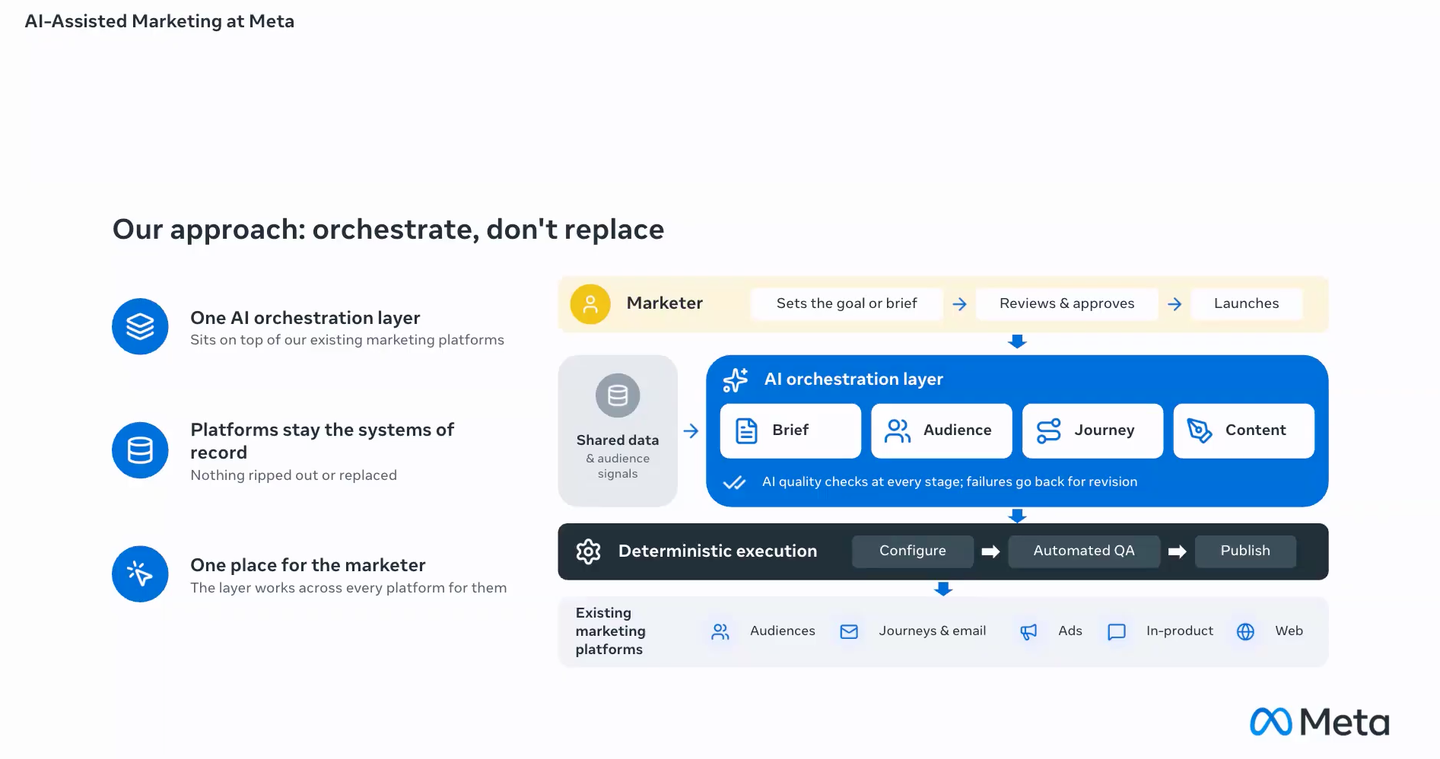
Their approach was to orchestrate, not replace. The marketer sits at the top. They set the goal, review and approve each stage, and launch. Underneath is one AI orchestration layer that works through the brief, audience, journey and content. Under that is deterministic execution, which configures each platform, runs automated QA and publishes. The platforms themselves "stay the systems of record. Nothing ripped out or replaced."
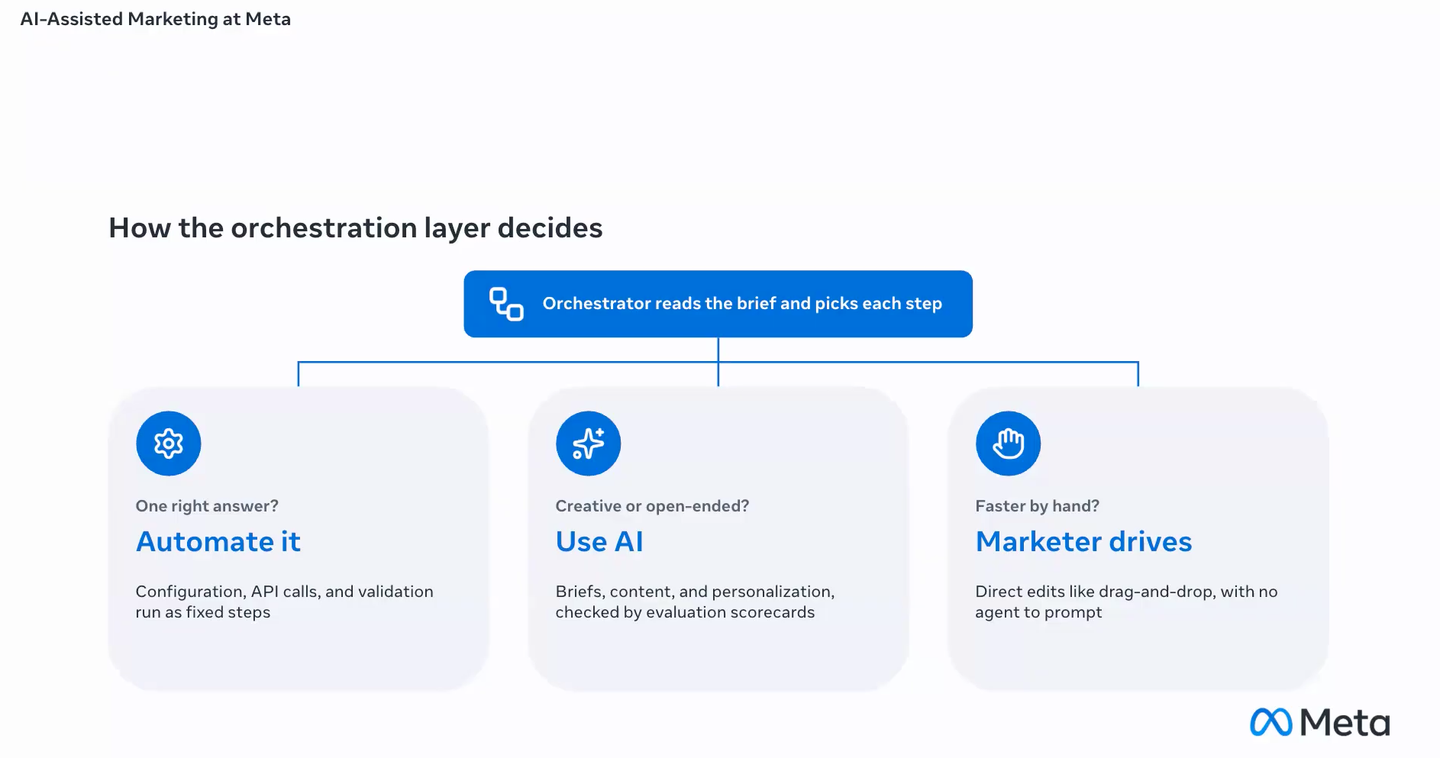
Max Martinez walked through how they decide who does each piece of work. There are three options:
- One right answer? Automate it. Configuration, API calls and validation rules. Variation doesn't help here. They need it done the same way every time.
- Creative or open-ended? Use AI. Briefs, content and personalisation, where there can be "multiple good answers." That "doesn't mean anything goes", so every AI output is scored against quality criteria that include marketing, legal and product standards.
- Faster by hand? The marketer drives. If a marketer wants to move a step in a journey, an agent will ask "Okay, where? Between which and which?" Dragging the node is quicker. The point is to save effort, and not every action needs to be a conversation with an agent.
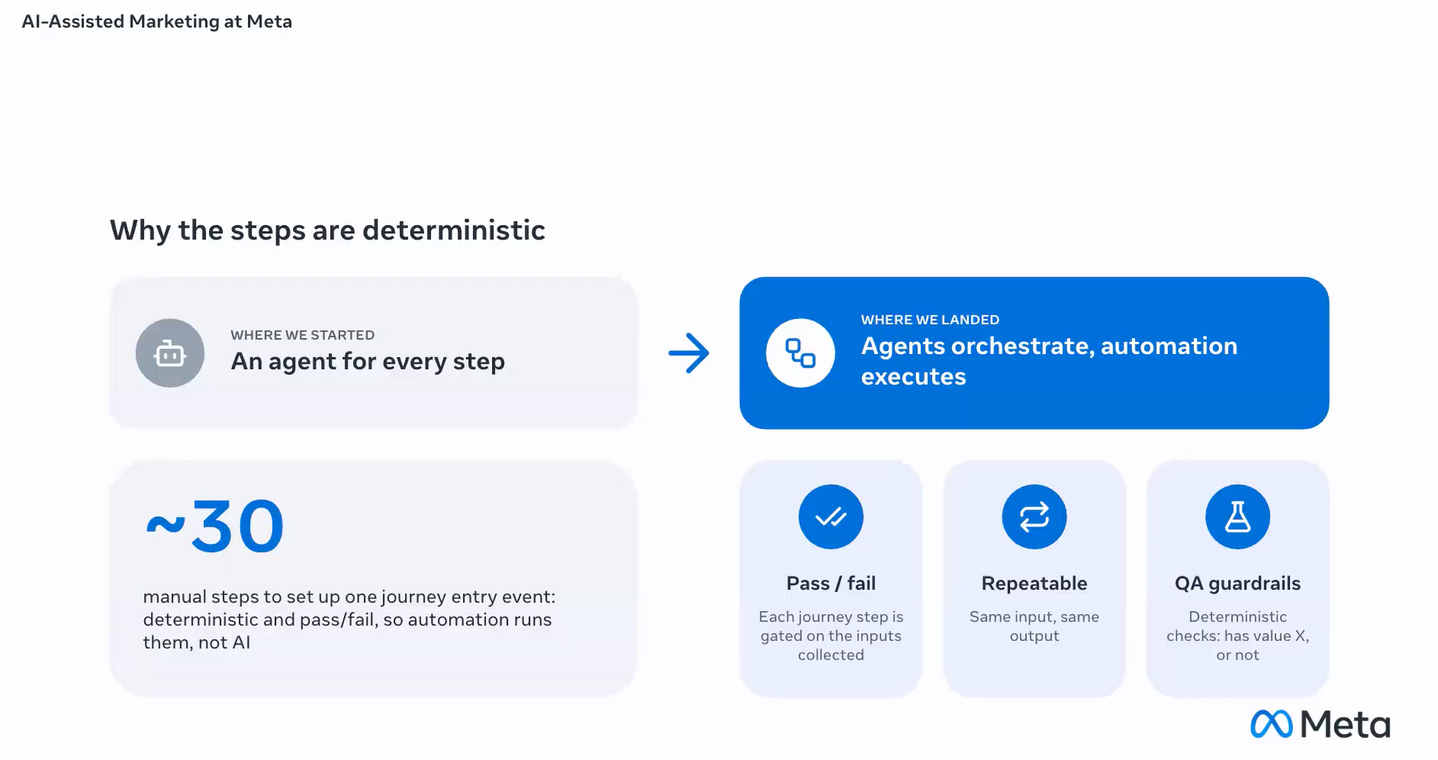
This wasn't the original plan. They started out wanting an agent for every step, including configuring the downstream tools. Then they looked at the actual work. Setting up a single journey entry event took about 30 manual configuration steps. Once the marketer has decided the audience and whether people can re-enter the campaign, the configuration just has to match those decisions exactly. "Each setting either matches the spec or it doesn't."
Making those steps deterministic gave them something an agent couldn't, which is a way to check the build. Is the expected audience configured? Is the re-entry rule right? Are the required values present? Each of those is a pass/fail check against the real configuration in the system of record. If the automation applies something wrong, QA flags the mismatch instead of marking the build as done.
OpenAI landed in the same place from the other direction. When they let AI run campaigns end to end, it sent emails to the wrong people and dropped unsubscribe links. One of their slides said: "More agent autonomy makes deterministic systems more important."
So the most advanced teams at an event about agents went less agentic.
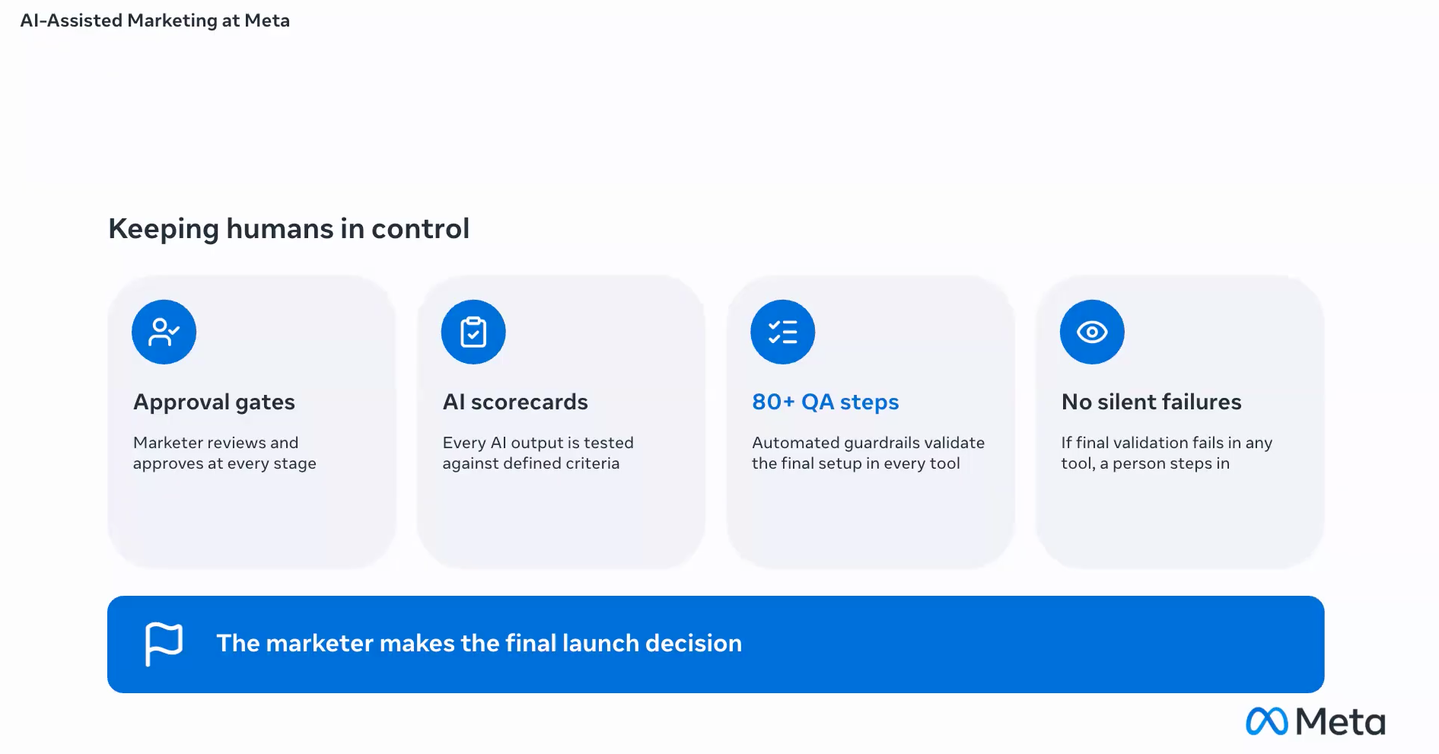
That split gives Meta two kinds of checks for two kinds of work.
For the deterministic steps, a QA checklist. They run 80+ automated QA steps, and they didn't have to invent them. Meta spent a decade configuring campaigns by hand, so they already knew every setting a person had to check. That list became the starting point for the automated checks. A person still owns it, adding checks as new channels come on and retiring old ones. AI doesn't get to decide what gets checked.
For the AI work, scorecards (evals). Rubrics that say what good looks like. Meta wrote theirs together with the creative, legal, marketing automation and martech teams, so everyone agreed on the bar before anything shipped.
And when something fails, AI doesn't get to fix itself. An expert in that area (audience, journey, creative or legal) works out what went wrong, fixes it, and then adds it to the evals or the QA checklist. Every failure makes the checks better.
Models change every few months, and the same prompt won't always give you the same output. Your checklist and your evals are what stay the same. They're your definition of good, written down. If you own those, you can swap models, change prompts or add channels and still know whether the work is right.
Try it: write down every setting someone on your team checks before a campaign goes live. That's your first QA checklist. Then pick one thing AI writes for you, and agree on a scorecard for it with whoever signs it off today.
5. NVIDIA: decide what you want to obsess over
Someone in the crowd asked why anyone would buy tools now that we can all build our own.
James Finlay from NVIDIA answered with a line from an old boss. Every job description, he said, is really asking "what am I paying somebody to obsess about?" You can put five of your own engineers on a problem, or work with a company that has a hundred engineers thinking about it every day. And people, he said, are only really good at three or four things.
So his test is simple:
"What do you want to obsess over and what's most critical for you and your business to obsess over?"
Jon Miller, who co-founded Marketo, made the same point about core systems like your CRM and marketing automation. Maybe you could build it, but do you want to maintain it, keep it secure, and keep it running when you're on vacation?
OpenAI and Snowflake both tried building it themselves first.
OpenAI built its own tool for building emails. Then an email went to one of their top customers on Outlook. Jeff hadn't tested in Outlook, and it rendered badly and broke the logo. The first version wasn't what worried him. Everything after it was: "Am I going to build the RBAC and the version controls… Am I going to maintain it?"
Snowflake set out to build every piece of their email command center, where a requester asks for something like an email to data engineers in Philadelphia and gets back the audience size, the best send date and a draft. Then, as Vivian Cheng put it, they realised they're "not really well-suited on Snowflake to build an email building app."
Both landed in the same place. Build where your own data or process is the edge, and leave the rest to tools built for it.
Before you build, ask:
- Is our data or process the edge here?
- Is this one of the three or four things we want our team obsessing over? If you've set your pillars, you already know.
- What happens when volume goes 10x, then 10x again?
- Who maintains it, secures it and fixes it when you're on vacation?
6. The panel: think in systems
When the panel was asked for one word on what marketers need to learn, one panelist said "I would say systems thinking."
If you want a clean definition, Sinéad Bovell wrote a short, sharp piece on this the same week. She describes systems thinking as "the ability to understand how the parts of a broader system connect and influence one another over time." It takes about three minutes and it's worth it: The Rise of Systems Thinking
It came up all day. Meta is hiring "systems thinkers". Kyle Christensen, CMO at Zuora, explained why. Getting a first version working is easy. Making it work at scale across the business is always much harder than you think. Corey McCarthy, CMO at Devicie, described what this looks like in practice. She had about 40 agents running within her first 48 hours in the job. Then her skills "became rather bloated", and keeping them current got hard. So she fired a bunch of agents. Now her agents get very simple instructions and pull the important details from her context layer, which is about 210 nested Confluence pages. "Not ideal, but it works." The agents stay simple, and the knowledge lives in one place that everyone else pulls from too.
Jessica Kao from Adobe, who spent years in operations herself, described the job as:
"the choreography of the dance between how humans hand off work to humans, humans hand off work to AI, AI hands off to AI, AI back to humans."
Hillary said it more bluntly: "if you're just going to be pushing buttons, they better be AI buttons."
Jon Miller made a similar point from the other side. Marketing automation rewarded specialists, and not because the tools were hard. Marketing ops itself is complicated. You had to know the right naming convention so the reporting downstream would work. He expects AI to take on more of that. In his words, "knowing the buttons to push in Marketo, maybe not so much anymore."
Look at who built the systems on stage. Jeff leads marketing ops at OpenAI. Christine runs campaign operations at CrowdStrike. Jessica spent years in operations. Meta's QA checklist came from ops people configuring campaigns by hand for a decade. Mapping handoffs, owning the rules about what can send and when, spotting where a process will break before it does... that's what MOps has always done. It's also exactly the skill every speaker said marketing needs now.
Put it all together
Put the sessions side by side and the same steps keep showing up:
- Intake where people already work
- A brief built from shared context, checked for what's missing
- An audience built from your own data and buyer signals
- AI drafts the content, automation does the configuration
- Automated checks and evals
- A human approves and launches
- Watch and learn
Underneath all seven is shared context and clean data. The teams that got furthest had done that work first.
I knew campaign production would come up. I didn't expect it to come up in almost every session. These teams could point AI at almost anything in marketing, and most of them started here. My guess is that's because campaigns are where marketing ops has the most handoffs, the most rules and the most volume. It's where the seven steps pay off first, and where they break first if you get them wrong.
It's also the problem we work on at Knak, so we showed our own version.
Tyron Pretorius from our team ran all seven steps live. He opened a Slack channel and, using his voice, asked Kai, our campaign agent, to create a follow-up email for everyone who attended the forum.
Kai already had the context it needed to write a brief: brand guidelines, messaging, personas, playbooks, notes from the kickoff meeting, and who on the team owns what. From that, it drafted the brief and created the project tickets so the team could track the work. Once the brief was agreed, it handed off to Knak, which built the email.
Tyron opened it in Knak to review. That's where the team can comment and ask for changes, and Kai can read those comments too. When he was happy, he synced it into the forum's Marketo program, merge tags already in place.
Back in Slack, he told Kai the email was synced, shared the attendee list, and asked it to load the list into the program and build a smart campaign to send it.
Before uploading anything, Kai stopped and asked for approval, because changing program statuses can set off other smart campaigns. Then it laid out how it would build the send: everyone in the program with a status of attended, the email Tyron had just synced, and our standard suppressions for anyone disqualified or unsubscribed. It noticed the list was a small test sample, left the suppressions out, and asked whether he wanted them back in. Tyron approved each step, and the email went out to the room.
Building an email takes minutes now. Planning and coordinating a campaign still takes weeks. The time goes into pulling the context together, writing the brief, setting up the project and chasing approvals. That's the part Kai is built for. Knak builds the email, and Kai handles the work around it, with a person approving anything that matters.
Humans still matter. Like, a lot.
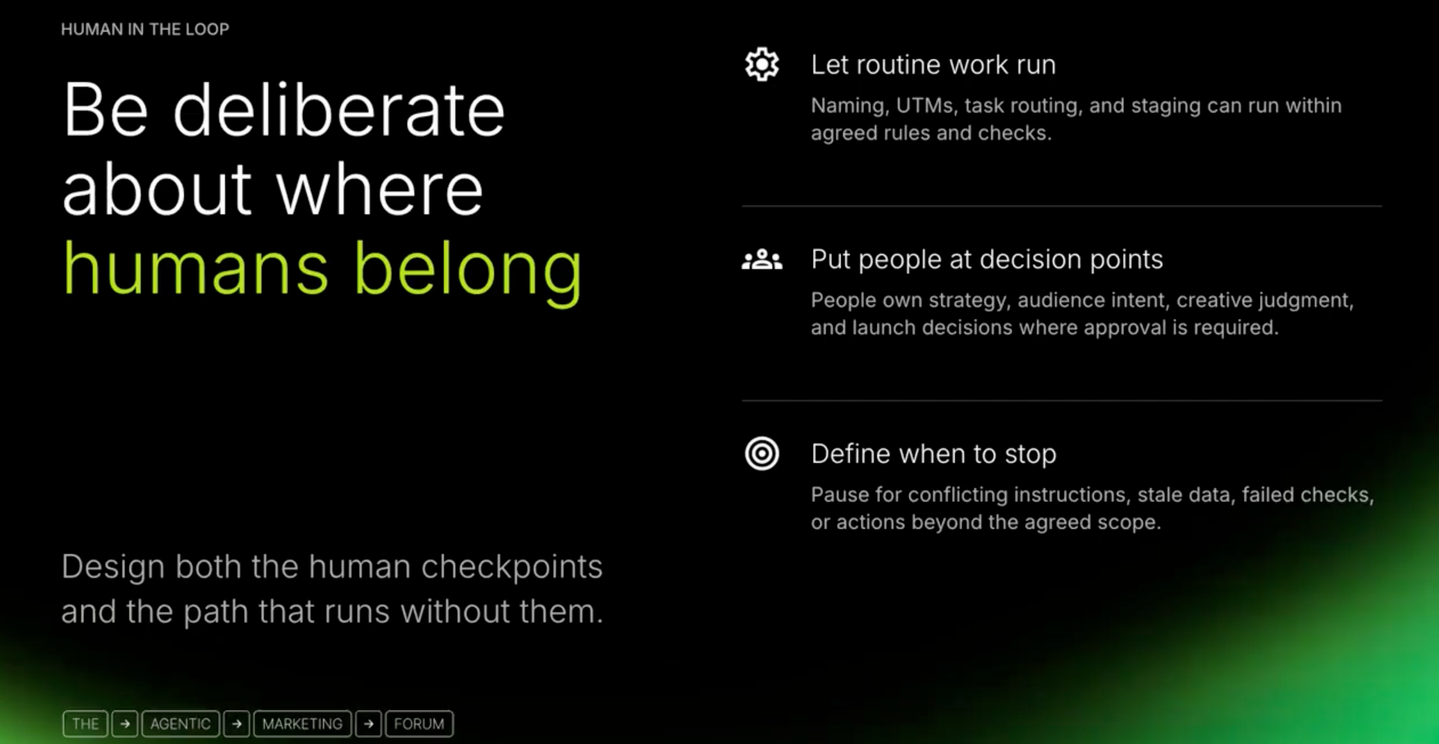
Every company on that stage kept people in the loop, and each one had clearly thought hard about exactly where. Meta has an approval gate at each stage and a person who owns the QA checklist. CrowdStrike sets how much an agent can do by what happens if it gets it wrong. At OpenAI, Jeff said humans are the ones "designing and setting those boundaries." Snowflake wants its team to be "decision makers as opposed to executors." Their answers were remarkably similar. People set the rules, approve anything a customer will see, and own the definition of good.
That's people inside the workflows. Step back and it's true more broadly too. How teams work is changing, but people are still very much in the picture.
Jessica told the story of an intern who built an agent for a field-marketing use case. "The design was great, the agents were great, the code was great." It failed anyway, because it needed systems it was never going to get access to. Anyone with a few years in the job would have spotted it: "of course you're not going to get those because that's PII." Her fix is to pair juniors and seniors from day one.
Someone asked Mark Organ, who founded Eloqua, how to keep marketers excited when they're worried about what all this means for them. He didn't pretend nothing would change. "The current job may not exist the way that it was," and there may be fewer of them. But he expects the people who make the transition to do more and get paid more, the same way a top enterprise sales rep or a great VP of demand gen earns far more today than 50 years ago. "It's because they're driving the value."
Across every session, the problem was really the same. How do you go from everyone being a bit faster with AI to a team that actually works differently? None of them started with the agent. They started with the system around it: the pillars, the intake, the tiers for what an agent can touch, and the checklist that says what good looks like. That's marketing ops work, and most of you have been doing it for years.
So pick the request your team gets the most and build your first block there. Nobody on that stage had it all figured out. You're not behind.
Kai is still early, and we're working with a few teams on it now. If you'd like to be one of them, get in touch.