AI in email production: What advanced adopters do differently


Industry research keeps landing on the same headline number for AI in marketing: roughly 70% of teams have adopted it. Our own Marketing Production in the Age of AI report agrees. We asked 333 senior enterprise marketers about their email production, marketing ops, demand gen, growth, and marketing leadership at organizations doing $50 million to $1 billion or more a year, all running an enterprise MAP, and 70% of them have AI working somewhere in the process.
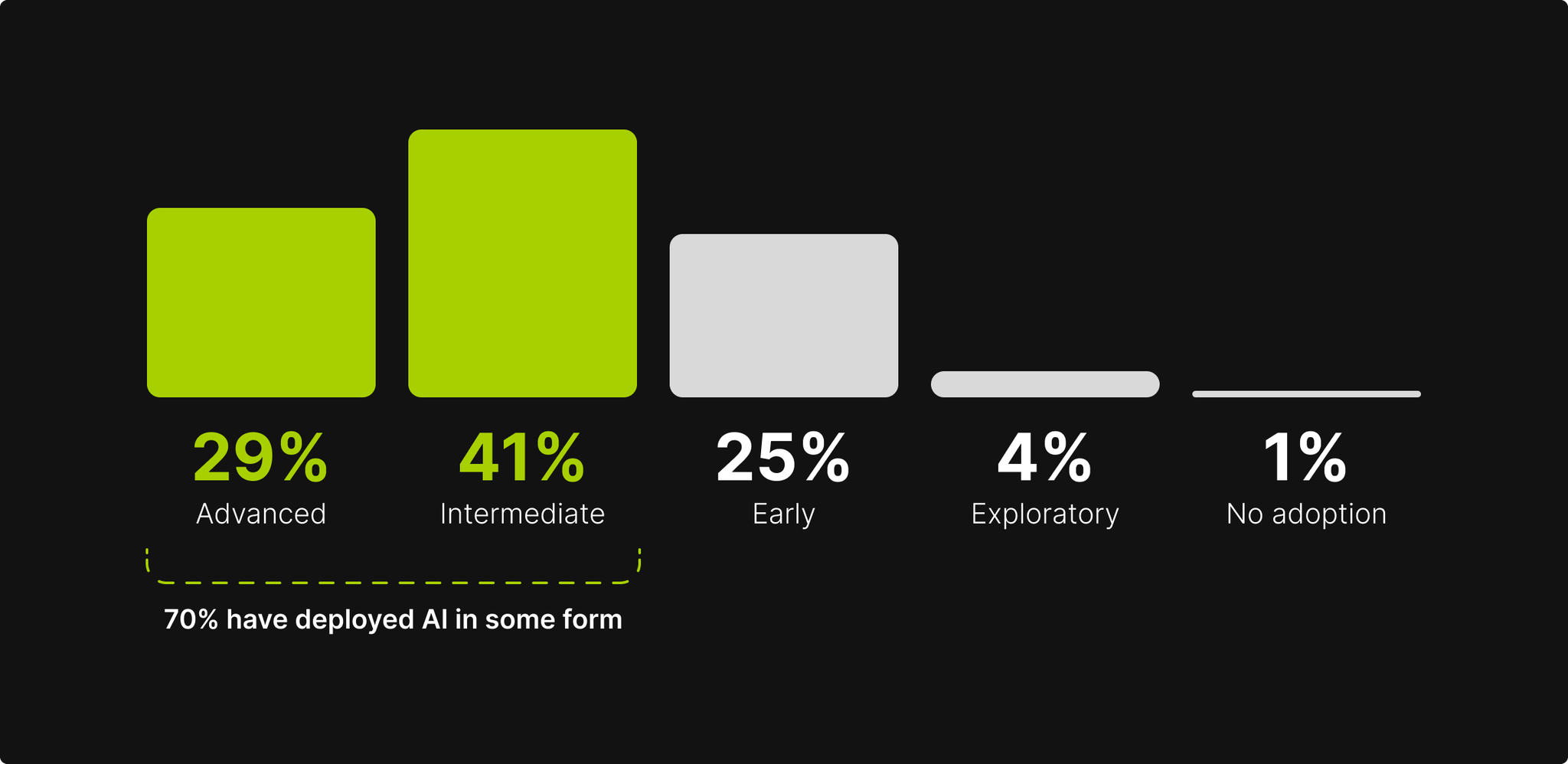
The number worth your attention is inside that 70%, because adoption means many things. In our survey it spans five stages, from exploratory use of a single tool for a single task all the way to advanced, where AI is embedded across the entire production workflow instead of pulled out for one job and set back down. Only 29% of teams qualify as advanced, and this post is about what's happening within the 70% through that lens.
The 29% didn't get there by buying more AI than everyone else. They built a workflow around the tools they already had, and the payoff shows up less in speed than in how their team feels about what ships: advanced adopters are twice as likely to call themselves very satisfied with the results. That's the question worth asking about your own AI investment: not whether it's deployed, but whether it's converting into work people are proud of.
What separates an advanced AI adopter from the rest
What separates advanced adopters isn't which AI tasks they've turned on. It's how many of those tasks talk to each other. Teams at every adoption stage touch the same tasks: 64% of teams use AI for first drafts, 56% for image generation or editing, 56% for analyzing performance data, 48% for subject line variants, 41% for brand and compliance checks.
What the advanced group has that the rest don't is a workflow where those tasks hand off to each other, instead of someone copying a draft out of one tool and pasting it into the next.
Most teams sit in the gap between those two groups: 25% at early adoption, 41% at intermediate, AI touching production somewhere but nobody's built the connective workflow around it yet. Only 1% report no adoption, and 4% call their use exploratory; those figures are small because every task above is easy to turn on alone. The 29% who count as advanced are the ones who stopped treating each task as its own decision and built one system instead.
Why advanced AI adopters are twice as satisfied with what they ship
Speed is the easiest number to point to, so start there. Advanced AI adopters are 56% more likely than the overall sample to produce a single marketing email in under an hour, 21% of them against a baseline of just 13% across the full survey. Most teams need a full business day or longer; advanced adopters clear a bar most teams never reach. On its own, though, that's a stopwatch number. What it buys the team is the more interesting question.
The answer is capacity. The same advanced-adopter group is 25% more likely to send 100 or more emails a month than the overall sample. A team that can turn one email around quickly can turn around more of them across a month without adding headcount, which is the real argument for AI in production: not that any single email gets faster, but that a fixed team can ship more without growing.
None of that would matter if it came at the cost of quality, and that's the assumption worth checking. Advanced AI adopters are twice as likely to describe themselves as very satisfied with their team's email and landing page performance as everyone else in the sample. The same group that ships faster and more often is also the group most satisfied with what it produces, which means the workflow underneath held up well enough that quality never had to compete with speed.
That's the question worth asking about any production speed number, yours included: is it giving your team more room, or just making the same output arrive faster?
How to close the gap between AI's mandate and its access
If the 71% who aren't advanced adopters yet are looking for where to start, the fix is rarely more training or willpower. It's access. Content Marketing Institute's 2025 B2B benchmark research found that 81% of B2B marketers say their teams use generative AI, up from 72% the year before, but only 19% describe that use as integrated into daily process; 54% call it ad hoc. Broad deployment, narrow integration, the same shape we found in our own data.
On our webinar, Jay Schwedelson of subjectline.com named why that gap holds open: "My frustration is that from the top, from the higher level, they say we use AI for everything. And then a lot of companies are not allowed to use some of the biggest platforms or they're not allowed to upload stuff, and then they wind up doing some sort of really horrendous version of using AI."
That's not a competency problem. The mandate arrives before the access does: leadership says use AI, legal and IT haven't cleared the tools that would let anyone use it well, and people improvise with whatever they've been given.
A team stuck at early or intermediate adoption isn't behind on a revolution it missed; it's still waiting on the access advanced adopters already have. Our HITL maturity curve maps that progression: individual exploration, then team-level tools, then agentic systems with human review built in. You're not falling behind by sitting on an earlier rung of it. Once access arrives, a team moves through the later stages faster than a bigger budget would take it.
What advanced AI adopters do differently in their workflow
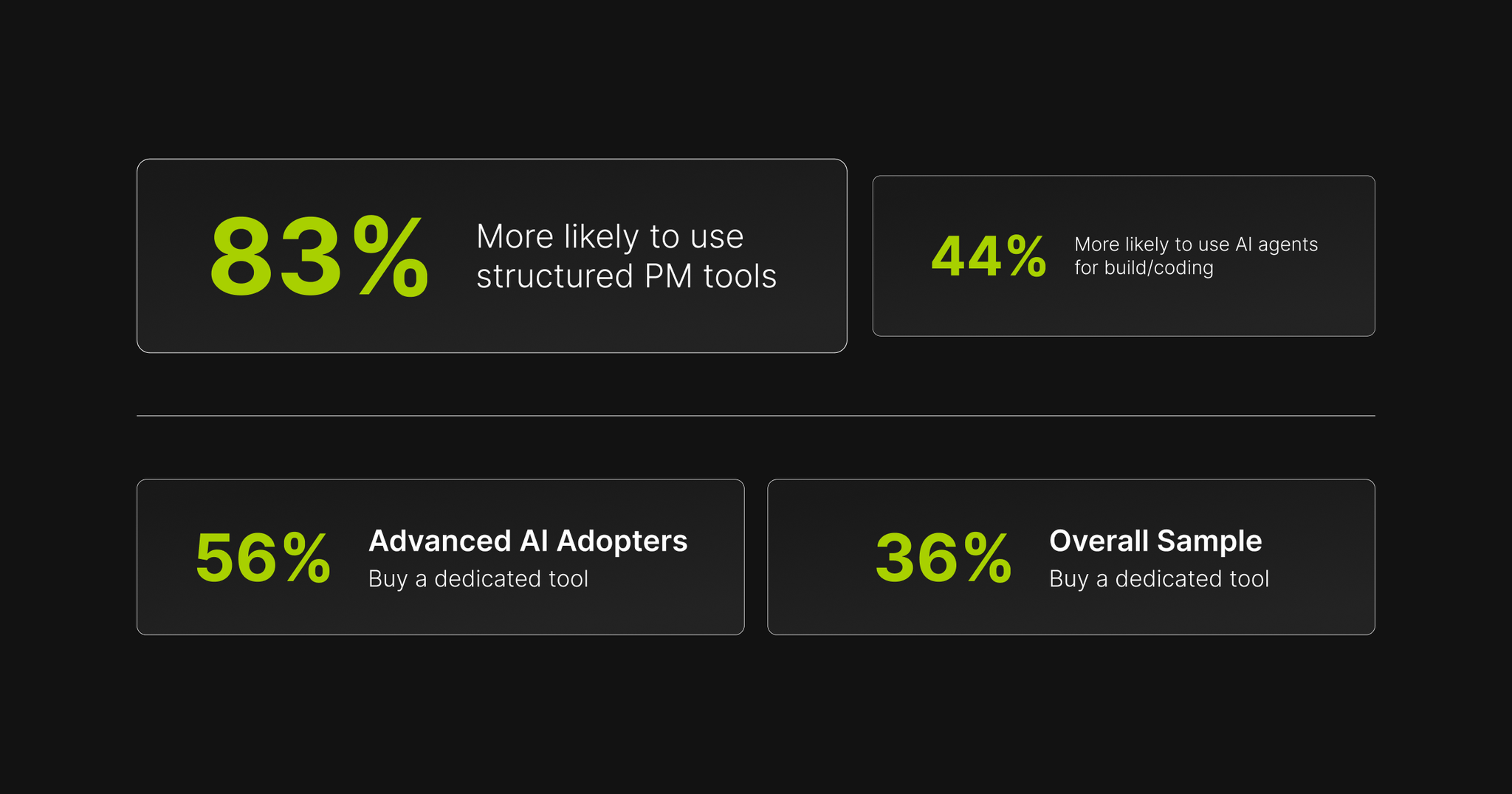
None of the six behaviors below require buying new AI. They're process and tooling decisions layered on top of AI most teams already have, which is why the 71% who aren't advanced yet can close this gap without a new budget line:
Behavior | Advanced adopters vs. overall sample |
|---|---|
Use AI agents to build or code emails and landing pages | 44% more likely |
Run brand and compliance checks through AI | 41% more likely |
Use AI for translation and localization | 34% more likely |
Use structured project management tools like Trello or Basecamp | 83% more likely |
Use native MAP approval workflows | 56% more likely |
Buy or subscribe to a dedicated tool when a capability gap opens, rather than patch around it | 56%, versus 36% overall |
Behavior | Use AI agents to build or code emails and landing pages |
|---|---|
Advanced adopters vs. overall sample | 44% more likely |
Behavior | Run brand and compliance checks through AI |
|---|---|
Advanced adopters vs. overall sample | 41% more likely |
Behavior | Use AI for translation and localization |
|---|---|
Advanced adopters vs. overall sample | 34% more likely |
Behavior | Use structured project management tools like Trello or Basecamp |
|---|---|
Advanced adopters vs. overall sample | 83% more likely |
Behavior | Use native MAP approval workflows |
|---|---|
Advanced adopters vs. overall sample | 56% more likely |
Behavior | Buy or subscribe to a dedicated tool when a capability gap opens, rather than patch around it |
|---|---|
Advanced adopters vs. overall sample | 56%, versus 36% overall |
Two threads run through that table. One is agentic: advanced adopters push AI further into the build and QA stages, past the drafting stage where most teams stop. The other is operational: they run the work itself, project tracking, approvals, tool decisions, with more structure than everyone else.
Neither thread alone explains the speed and satisfaction numbers above. The gap opens only once both show up together, and that combination is a workflow choice, not a bigger AI subscription.
That's what AI built into the production workflow looks like in practice, not a pitch. One customer's stack runs the agentic thread end to end. OpenAI's marketing team types a campaign brief into Slack. Knak's MCP integration generates a first draft from that brief. The team edits it from there, and marketing operations deploys the finished asset, all without leaving the thread where the brief started. That's the 44%-more-likely figure above, in practice: AI doing more than drafting, connected into the rest of production.
AI output still needs heavy editing, even for advanced adopters
None of this removes the editing step. 88% of teams say AI-generated marketing content needs moderate or substantial editing before it goes out, and that number holds steady no matter where a team sits on the adoption curve. Only 1% report using AI content with little to no review.
Sara McNamara, a RevOps and marketing operations leader on our panel, put her finger on why: "I don't think it's great at creating the final product, and I think that's why we see this show up here where it's like, the idea was pretty good, but then we really needed to inject some heavy editing in there."
She's right, and it's not just an internal read. Gartner's June 2026 survey found that 49% of U.S. consumers agree that generative AI has made the overall quality of content available to them worse. Readers notice the same gap Sara describes from the inside, which makes skipping editing more than a process risk.
Advanced adopters aren't skipping that step. They're the group most likely to have brand and compliance checks and structured approval built around the draft before a person ever opens it, so what lands on someone's desk has already cleared the easy problems. That's a meaningful part of why this group holds speed and quality at once instead of trading one for the other.
How to move your team up the AI adoption curve this quarter
Closing this gap doesn't start with a bigger AI budget; it starts with an audit: take the six behaviors in the table above and check off which ones your team already does. A team using AI for drafting but still routing approvals through email threads has found one specific, fixable gap, and closing it doesn't require replacing the AI tool already in use.
The same staged logic holds outside AI. Our cross-channel messaging maturity curve maps a comparable progression for teams adding channels beyond email: moving up only pays off once the production system underneath can support the added complexity. A team that rushes agentic AI workflows onto an approval process still running through scattered Slack threads hits the same friction as a team adding a channel without a production home built for it first.
29% of teams have already made that jump, and what happens once they do is what this data describes: faster production, higher volume, and a team more satisfied with what it ships. The rest of the sample has access to comparable AI tools already. What separates the two groups is the workflow built around them, and that's the part every team can start building this quarter.