How many tools does it take to create and send one marketing email?


How many marketers does it take to screw in a lightbulb? Swap the lightbulb for a marketing email and it stops being a setup: four or more people, three to five tools, sometimes a full business day for a single send. From the outside, that looks absurd. From a seat at the table, under that light, it looks like a deliberate process, and mostly it is one. Every person in the chain is there because something went wrong once without them.
For our Marketing Production in the Age of AI report, we asked 333 senior enterprise marketers to walk us through their own stack: marketing ops, demand gen, growth, and marketing leadership at organizations doing $50 million to $1 billion or more a year, all running an enterprise MAP. The punchline: the email itself is the easy part. Everything around it is where the real cost lives, starting with a question most teams never ask themselves. Is production actually getting better? Faster, sure, everyone assumes AI made that true. More accurate, cheaper per send? Nobody checks, because nobody thought to ask until we put a number in front of them.
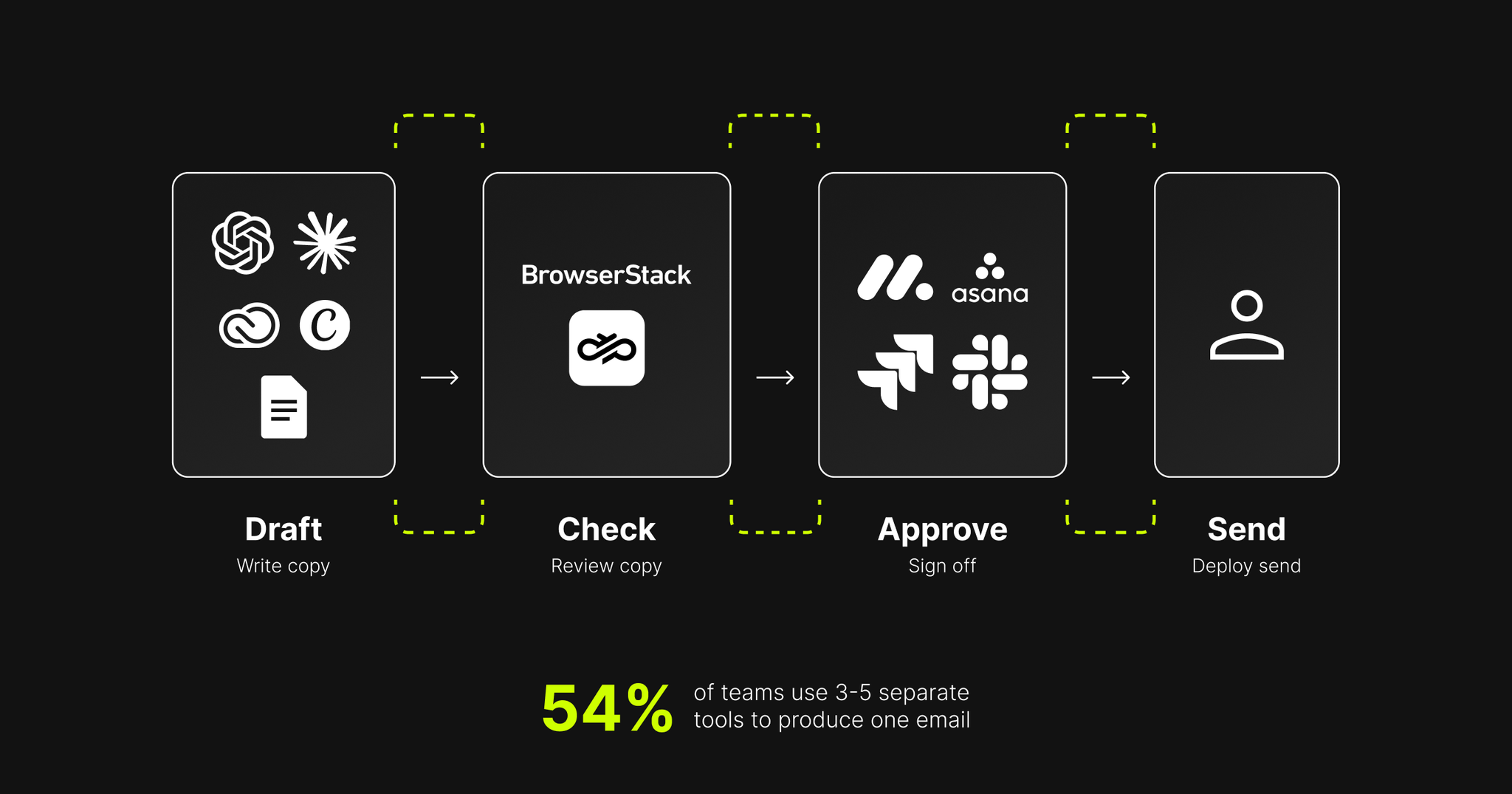
64% of teams now use AI to generate first drafts of email and landing page copy. 54% still stitch together three to five separate tools to get one email out the door, the same range teams reported before generative AI showed up. The draft got faster. Whether the process around it got any better is the real question.
What each tool in the email stack is for
Ask why one email needs three to five tools and the honest answer is: no single stage does, but the stages add up. 54% of teams run three to five separate tools to move an email from brief to send. Copy and creative move through ChatGPT, Adobe Creative Cloud, Google Docs, Canva, or Claude: the drafting job. Quality checks run through manual testing, a MAP's native preview, or dedicated tools like BrowserStack, Litmus, and Email on Acid: the checking job, catching broken renders and dead links. Review and sign-off happen in Microsoft Teams, Slack, Asana, monday.com, Jira, or Smartsheet: the approval job, because someone with brand or legal authority has to put a name on a send. Draft, check, approve, send. Four jobs, at least one tool built for each.
None of those jobs disappears because a platform sits on top of the stack, Knak included. A compliance reviewer isn't signing off inside a Google Doc comment thread. What breaks isn't a job; it's the handoff between them.
Landing pages get dedicated tooling more often than email: 49% of teams use a dedicated landing page tool, against 36% who use one for email alone (another 36% use the same tool for both), which is proof the tools work once a job gets one built for it. Email is the outlier: it carries more volume and more brand scrutiny, and it's still the channel more likely to get drafted in a Google Doc and approved through whatever thread catches the right person's attention.
What AI drafting has fixed in email production
AI's biggest production win sits at the start of that stack. 64% of teams use it to generate first drafts, more than any other AI use case we measured, in line with the wider market: Content Marketing Institute's 2025 B2B benchmark study found 81% of marketers now use generative AI, up from 72% the year before. What AI fixed is real: a drafting stage that used to eat the first hour of a brief now eats a few minutes.
What AI hasn't touched is everything downstream, and the same CMI study shows why: only 19% describe their AI use as integrated into daily process, and 54% call it ad hoc. Grow & Convert's independent survey of marketers and writers found 60% say AI-generated content needs more editing than content written from scratch, and more than one in five end up rewriting AI drafts entirely before anything ships (sample size not published, read directionally). It's a scope mismatch: solving the drafting job doesn't solve the checking or approval job downstream, and that gap is where the real quality-and-ROI question hides. Is your team's production time actually down since AI showed up, or did it just move to a stage nobody's tracking? Most teams can answer the first half. Almost none can answer the second.
How to get real time savings in your marketing production flow
If AI closed the gap at drafting, our report points to exactly where the next one is open. 47% of marketing decision-makers name approvals and sign-off as their team's biggest challenge to launching campaigns on time, ahead of design production (38%) and coordinating across teams (36%). That's not really an approvals problem. It's a findability problem wearing one, and the fastest fix doesn't touch a single tool. It touches where the real, current version of an email lives while it's still in flight.
Sara McNamara, a RevOps and marketing operations leader who joined me on Knak's panel discussion of the survey findings, named the exact shape of that problem.
"I hit you up for an edit, and you're like, what? Where? You're searching your email, searching Slack. Where is it?" she said. "And you spent an hour just trying to find it."
That hour is a classic production tax: an edit gets flagged in the tool where the conversation is happening instead of the tool where the draft lives, so someone has to hunt for it before they can act on it. Closing that gap is where real savings come from. Route comments and sign-offs through the one place the asset already lives, so "where is it" stops being a question anyone asks twice. Give one person clear ownership of the brand-and-copy pass instead of splitting it across two reviewers who each assume the other owns it. Neither fix requires a new tool; both require deciding, in advance, which version is real.

Why the fastest teams still run the same number of tools
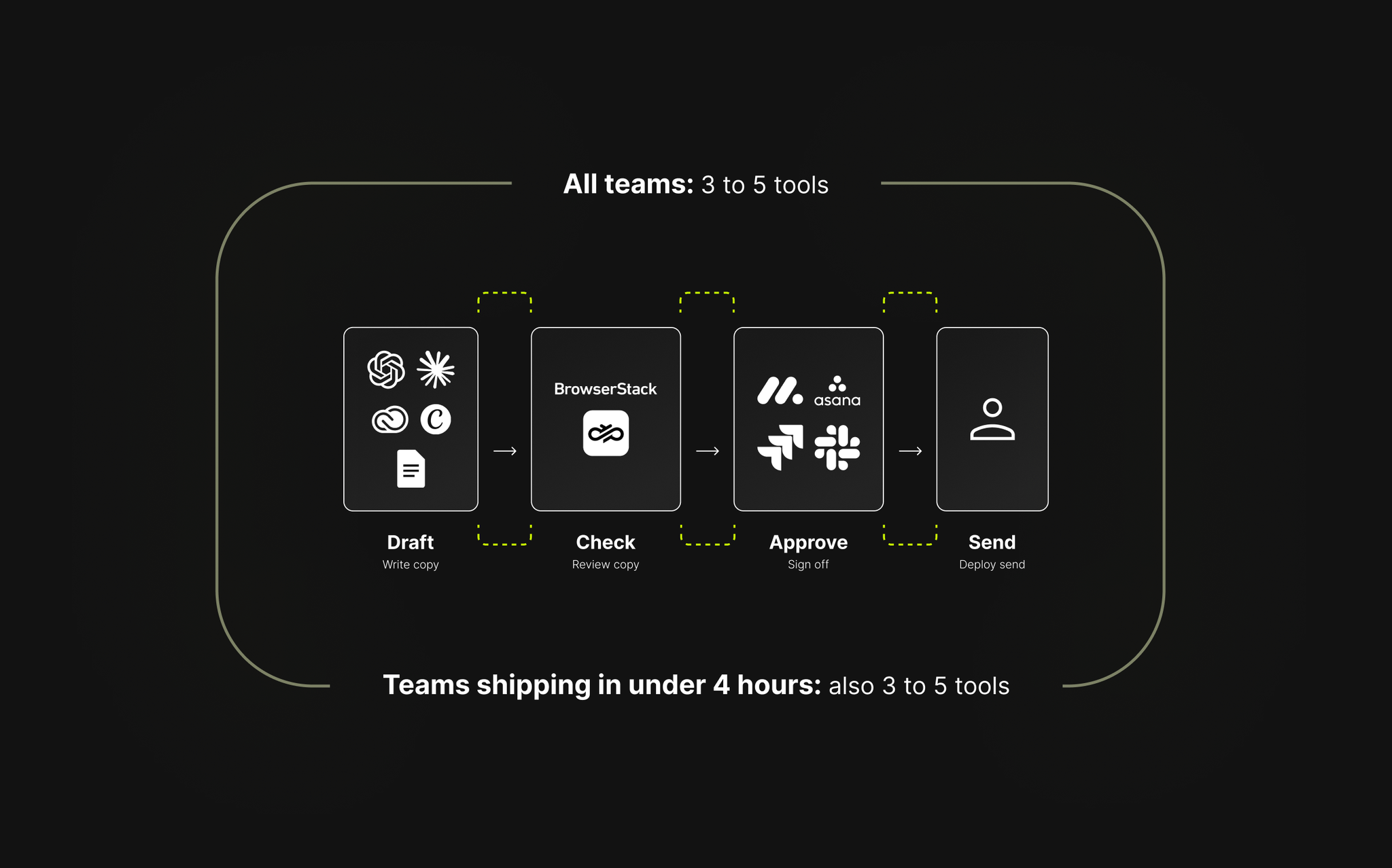
It would be easy to conclude the fix is fewer tools. Our data on the fastest teams says otherwise: teams that go from brief to send in under four hours run three to five tools, the same range as the overall sample. Tool count isn't what separates a four-hour team from a four-day one. The enemy was never the number of tools. It's what a team lets those tools cost in handoffs, duplicate reviews, and edits nobody can find.
What separates a fast team is who has to look at the email before it ships, and how directly they can act on what they see. A four-hour team still uses a content tool, a QA tool, and an approval tool. It just doesn't route every asset through every reviewer. Campaign orchestration gets built for exactly this reason: to give each tool a defined job and a clean handoff to the next, rather than to remove any of them. That's also what a stack of connected marketing automation integrations buys a team: the same tools, wired so an asset moves without a person carrying it.
Picture the same five tools running two different teams. On one, a draft moves into a shared review doc, a Slack thread flags a brand question, and that question surfaces again in a separate approval tool because the brand reviewer doesn't check Slack, so the email sits until someone notices the duplicate ask. On the other, the same five tools are wired to the same brief, one reviewer owns brand and copy in a single pass, and the approval tool is the only place a sign-off happens. Same headcount, same stack, same channel. One team ships in an afternoon and can tell you why. The other waits three days for a question that only needed one answer.
Running the same audit on your own team
Our own methodology is a reasonable model for auditing a stack. Map every tool an email touches from brief to send, note who owns each handoff, and time how long the asset sits between steps rather than how long each step takes. Most teams that run this find the steps are fast and the gaps between them aren't.
Three questions surface the gap quickly:
- Who has to approve the email, and could that list survive being cut in half?
- When a reviewer flags a change, does it land in the same tool the draft lives in, or does someone relay it across a second system?
- How long does an email sit waiting on one person, versus how long anyone is actually working on it?
None of these questions require new data. The answers are sitting in whatever tool tracks the team's last dozen sends; few teams ever go looking.
The audit gets harder as a team adds channels. A stack built for three to five tools has to stretch further once SMS, push, or paid social assets move through the same review chain. Cross-channel campaigns need one production home instead of a longer sequence of channel-specific tools bolted on.
AI closed the gap at drafting faster than most of us expected. The tool count was never the problem, and cutting it isn't the fix. The fix is knowing what each tool is for, who owns the handoff to the next, and whether the whole thing is getting better instead of just feeling faster. That's the part of the lightbulb joke nobody tells: counting the marketers was never the point. Knowing what each one is there to do is.
Explore the full data set in our Marketing Production in the Age of AI report for the complete breakdown of tool usage, AI adoption, and launch-timing challenges this post draws from.