How much does it cost to create a marketing email? (2026 data)


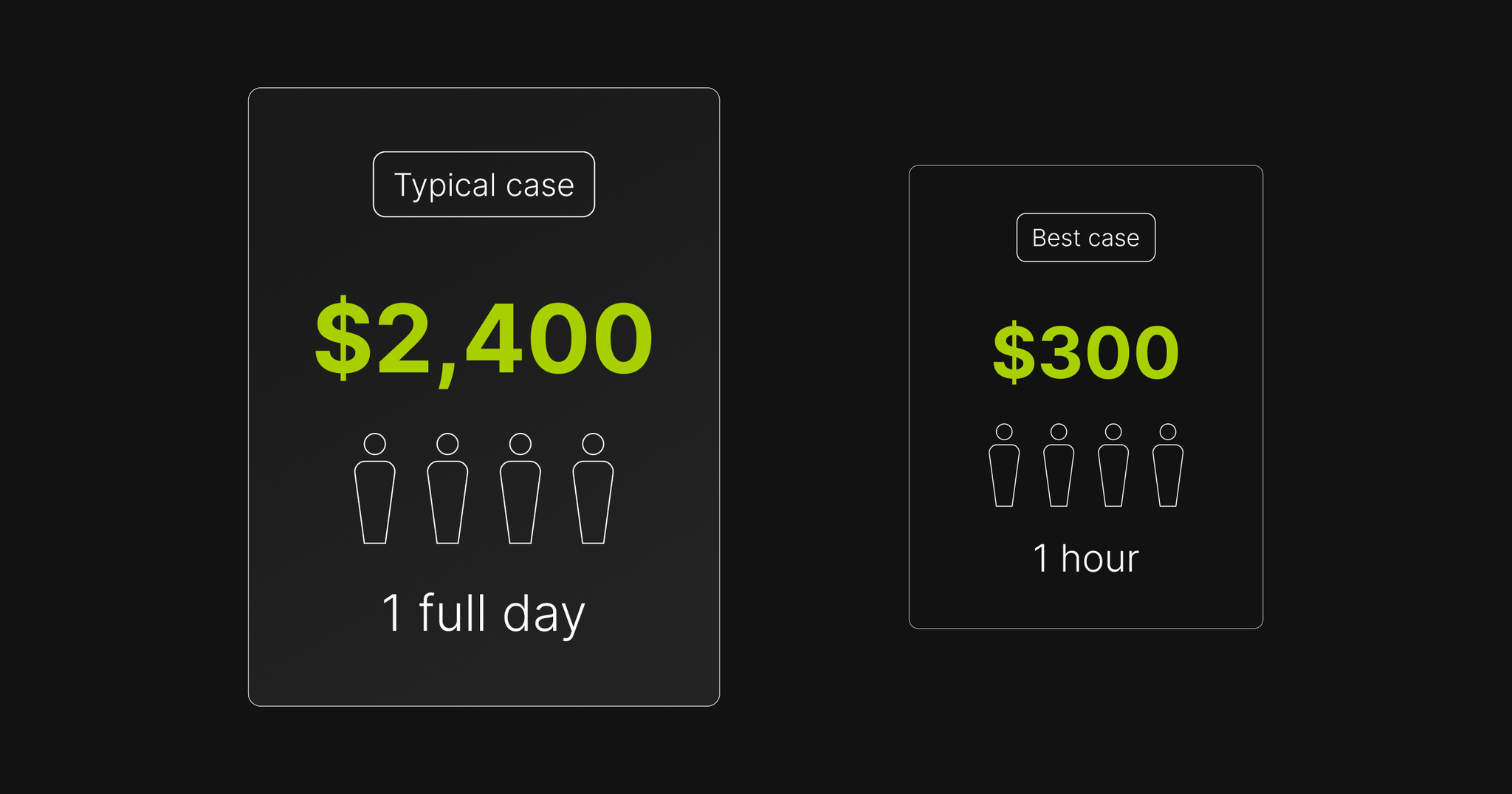
Did you know an enterprise marketing email can cost up to $2,400 to produce? That's for a single email, taking a full day from brief to send. It's what our Marketing Production in the Age of AI report found when we asked 333 enterprise marketing decision-makers to walk us through what it takes to get one email out the door. Nobody on our webinar panel was surprised by it. Sara McNamara and Jay Schwedelson both called it out as the number that got under their skin.
Ask Google the same question and its AI Overview will tell you an email can be free, or close to it. Honestly, it's not wrong. One person, no legal review, no brand check, working out of a template: that really is close to free. Now put a real MAP, a real send calendar, and an approval chain with more than one name on it behind that same email. The math changes fast.
What it costs to produce one marketing email
We built this number from Bureau of Labor Statistics wage data for marketing managers, run against what our own respondents told us about their team size and their timelines. In the best-case scenario, production takes about an hour and four people are in the room. Even there, internal labor costs run past $300 per send. Stretch that same four-person team across a full day of building, reviewing, and approving, and the same math lands at roughly $2,400 per email.
Neither number is a worst case. They're the two ends of what a normal team, doing normal work, spends. We built the report on 333 senior marketers: marketing ops, demand gen, growth, and marketing leadership at organizations doing $50 million to $1 billion or more a year, all running an enterprise MAP and sending real volume every month. Blue-chip respondents, and I'll say that with some pride. This isn't a convenience sample.
Why the cost of a marketing email varies so much
Two things move a team from the $300 end of the range to the $2,400 end: how many people touch the email, and how long it sits with each of them.
60% of teams need four or more people to get a single email from brief to send. Nearly one in four need seven or more. Jacqueline Freedman, a marketing operations advisor who sat on our panel, put a number on what that means in practice. "Nearly one in four marketers have seven or more team members involved in producing a single email... If a quarter of our marketers have to appease seven to who knows how many people, it's nearly an impossible task."
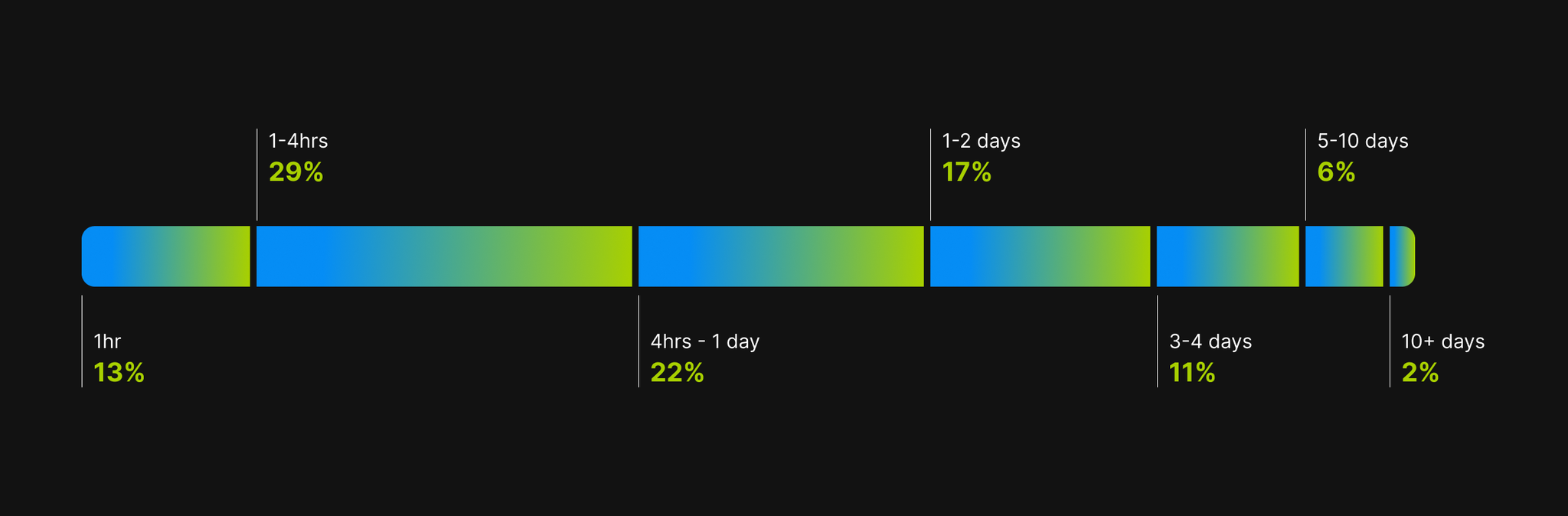
Time tells the same story. 36% need at least a full business day to move one email from brief to send, reviews and approvals included. Picture the two teams side by side. A mid-market team runs the report's baseline four people through an hour of work: draft, template, one reviewer, send. An enterprise team runs the same four roles through a full day: brief handoff, a design round, a compliance check, a director's sign-off booked back to back. Nothing about the work changes. What changes is how long each step waits in someone's queue before it moves. That gap comes down to queue time, and it's why we built Knak's email production platform around removing the wait rather than the work.
What our panel said about the $2,400 email
On our webinar, Sara McNamara, a revenue and marketing operations leader, didn't hear the figure as an abstraction. "I would say that $2,400 per email, it didn't really surprise me, but, again, like Jay, it kinda irritated me," she said. "It was inflammatory because I think so often, on the flip side, teams under invest in email. And so they throw a million people at the problem, and then they don't realize how much that costs, like, all the attention span, the working hours, the back and forth." Then the line that reframes the whole question: "I think it's easy to just say email is the highest ROI channel, which I agree with, but is it the lowest cost? Are we diluting that a bit if we're not very efficient with how we run it? Probably."
She's right to be irritated. We all treat email as the cheap channel, the one worth leaning on because it's supposedly free. It isn't, not once you count the hours and the people and the platforms it takes to get one out the door. None of this is an argument that email underperforms. It's the same blind spot every time: we measure what email returns without ever pricing what it costs to make.
Why revision rounds drive up email production costs
Headcount and queue time explain most of the gap between $300 and $2,400. Revisions explain the rest. 69% cycle through two to three rounds of revision before an email gets approved, and every round sends the same four to seven people back through the same review chain again. One revision round doesn't double a team's cost. Three of them, stacked on top of an approval chain that's already slow, is how a team ends up on the wrong side of the range without anyone deciding to spend more.
The pattern shows up outside our own data too. Across B2B marketing broadly, 81% of marketers use generative AI tools, but only 19% say that use is actually integrated into the daily process, and 54% call it ad hoc, per Content Marketing Institute. A July 2026 CMO Council audit of 200-plus marketing leaders, over half at companies doing $500 million or more, found the same shape at the operational level: fragmented data, disconnected workflows, and underperforming stacks despite years of martech and AI spend. A faster first draft doesn't touch a legal check. It never has.
Finding your own email production cost
Sara's advice to the panel was practical: run the audit internally before you take the case to leadership. "I think doing your own audit... you probably can just do that internally," she said, pointing to the same method we used to calculate the report's own figures. The inputs are the three numbers this post has walked through: how many people touch a single email, how long each step sits before it moves to the next person, and how many revision rounds it goes through before approval. Multiply loaded hourly cost by hours spent, add it up across the team, then multiply by revision rounds. That's a real production number, and it beats a vendor's average walking into a budget conversation.
Sara also had a thought on what to do with the number once you have it. "When you're looking at budget and you want to talk with leadership, be like, look at what we're spending," she said. "I've calculated if we cut this amount out, we can save this amount per email." Teams that have already mapped their own production stages, the way our email creation maturity model lays out, move through this exercise faster. The stages already have names. Nobody has to reconstruct them from a Slack thread first.
Email earns its reputation as the highest-ROI channel in marketing for good reason. What this data adds is the other half: the channel carries a real production cost, and most teams have never priced their own version of it. Spending close to $2,400 on an email isn't automatically a mistake. You might be running the review chain a genuinely complex send requires. The risk is never running the number and finding out only when someone finally asks where the budget went.
Explore the full data set in our Marketing Production in the Age of AI report for the complete breakdown of team size, production time, and revision cycles this post draws from.