

How long does it take to make a marketing email? At Amazon, under 10 minutes. At Vanguard, 8.8 minutes. During early testing, DocuSign's brand creative team averaged about six.
Now ask how long it takes to send one. In our Marketing Production in the Age of AI report, 36% of enterprise teams need at least a full business day to get a single email from brief to send. Most of the rest need hours.
Both numbers are true, and they don't contradict each other. They measure two different things, and most benchmark conversations mash them into one. Pull them apart and you find out where your production time goes, which is the only benchmark that's much use to anyone.
How long it takes to produce a marketing email in 2026
Start with the good news, because there's plenty of it. Industry research tracked by Litmus shows email production speeding up fast: in 2023, 62% of marketing teams needed two or more weeks to produce a single email, and by 2025 only 6% did. Today 76% of teams produce an email in a week or less, up from 21% in 2023. Two years ago, weeks were normal. Now they're rare.
Our own survey picks up where that trend leaves off, and I'm proud of who answered it: 333 senior marketing ops, demand gen, growth, and marketing leaders at $50 million to $1 billion-plus organizations, every team running an enterprise MAP and sending real volume every month. We asked how long it takes them to produce one email from brief to send, every review and approval included. Here's the spread:
Time from brief to send | Share of teams |
|---|---|
Under 1 hour | 13% |
1 to 4 hours | 29% |
4 hours to 1 day | 22% |
1 to 2 days | 17% |
3 to 4 days | 11% |
5 to 10 days | 6% |
10+ days | 2% |
Source: Marketing Production in the Age of AI, 2026, Knak.
The industry has mostly moved from weeks to days, and a real slice of teams has moved to hours. Only 13% get an email out the door in under an hour, and more than a third still need a full day or longer.
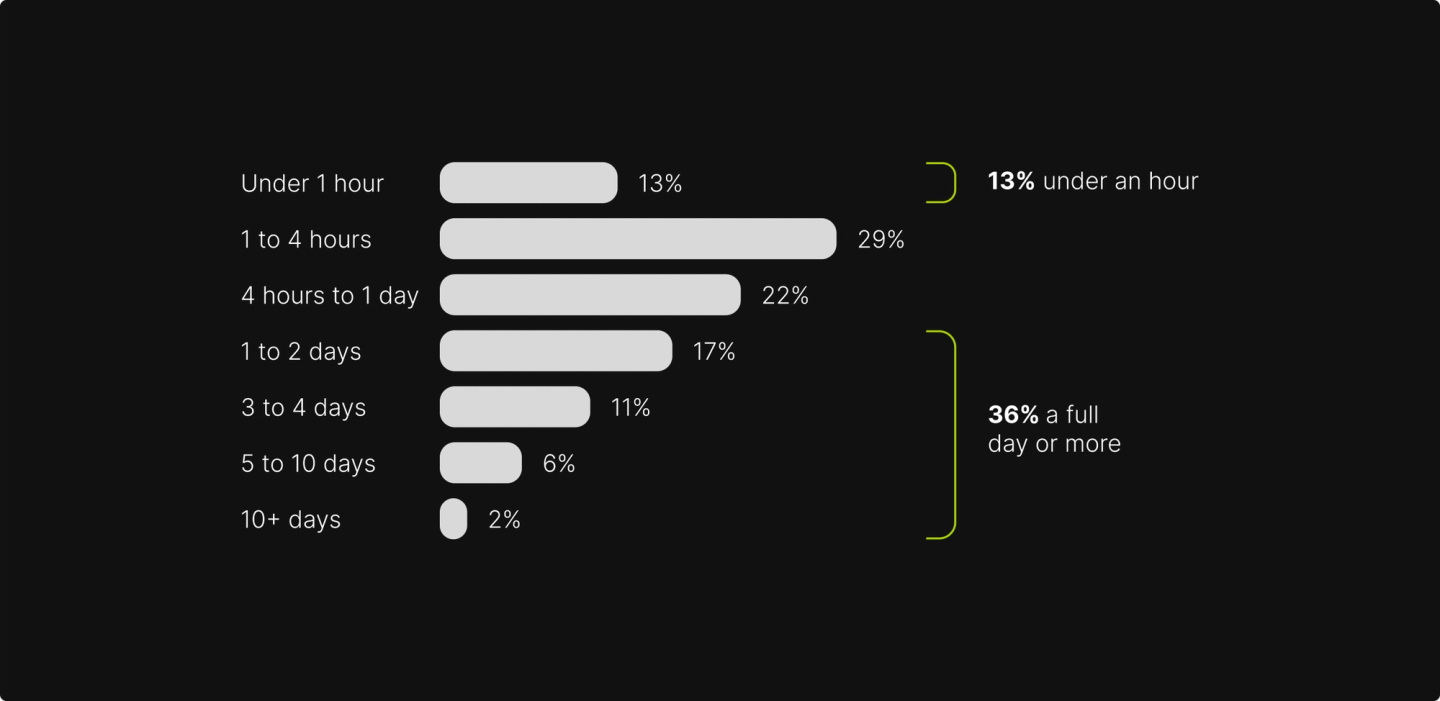
Email production has moved from weeks to days, and 13% of enterprise teams now get one out in under an hour. (Sources: Litmus, via Knak's email creation statistics; Marketing Production in the Age of AI, 2026, Knak)
What real customer build times look like
Our customers publish a different kind of number. Here's what four of them report:
Team | Average build time | What else changed |
|---|---|---|
Amazon | Under 10 minutes | 95% reduction in email build time |
Vanguard | 8.8 minutes | 59% faster time to market, 40% more assets produced |
DocuSign | About 6 minutes (early testing, 45 emails) | Up to 90% less creation time than its HTML process |
Uber | 11 minutes | Deployment time down from about 10 days to 4.5 |
Sources: Knak customer stories for Amazon, Vanguard, DocuSign, and Uber.
Amazon's story is the one I come back to most. The team went from more than three hours per email to under ten minutes by building a library of on-brand, reusable modules instead of starting each email from scratch, and its campaign lead times dropped from weeks to days. Andrew Eberting, Amazon's Head of Global Martech and Operations, put it in terms every marketing leader understands: "Time is the currency. If I can give my team hours back by removing friction, that's the ROI."
It's tempting to line these numbers up against the survey and declare a winner. Resist it. Every number in that table is build time: how long it takes to assemble the email itself. The survey measured the whole trip, brief to send, with every review and approval along the way.
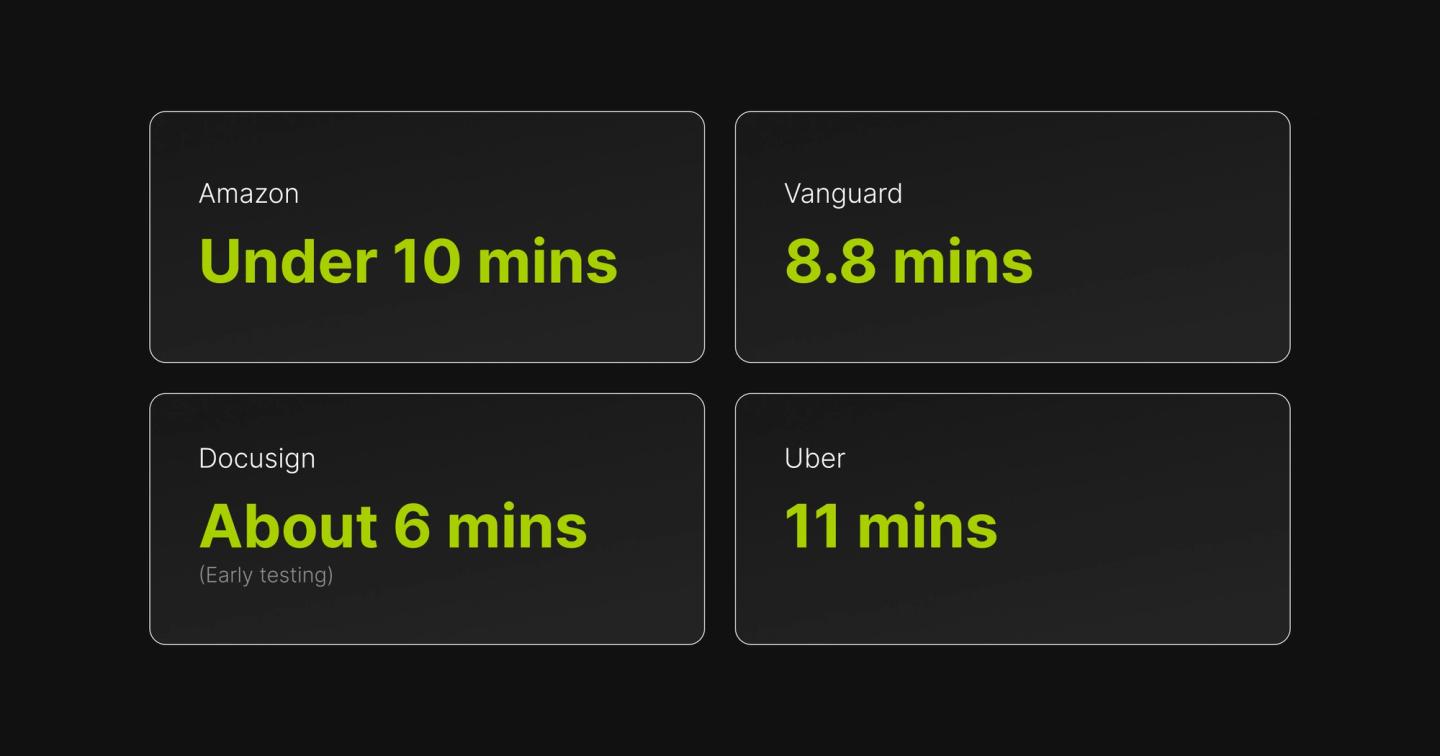
Enterprise teams on Knak build an email in minutes. Building is only part of the trip from brief to send. (Source: Knak customer stories)
Why email build time and send time are two different benchmarks
Uber's story shows the difference better than any other. Its teams build an asset in 11 minutes on average. Its deployment time, the stretch that includes translations and approvals, dropped from about 10 days to 4.5 days, and half of its assets now deploy in under 24 hours.
That's a remarkable improvement, and it still means the build is a small fraction of the trip. Eleven minutes of building sits inside days of everything else: requests, translations, reviews, approvals, and QA. A global brand needs those steps, and I'd worry about one that skipped them. They simply take more time than the build, and they always will.
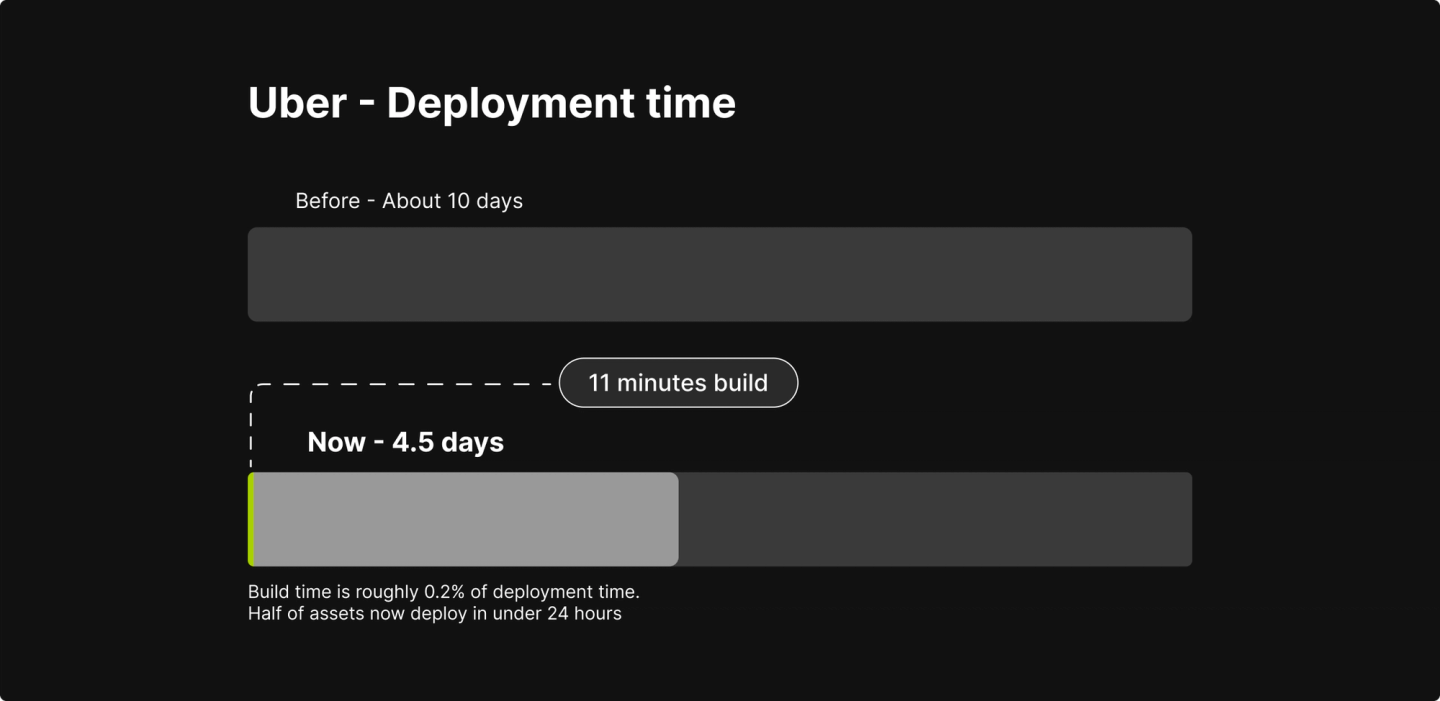
At Uber, building an asset takes 11 minutes. Getting it through translation, review, and approval takes days, and that's where the next gains are. (Source: Knak customer story, Uber)
Our survey shows the same shape across the industry. 60% of teams need four or more people to get a single email from brief to send, and 69% cycle through two to three revision rounds before approval. Each of those people and each of those rounds adds waiting time, and none of it shows up in a build-time number. That's why a team can cut its build to minutes and still land in the one-to-two-day bracket. The email is ready; it's waiting in someone's queue.
It's a pattern the wider industry recognizes. A July 2026 CMO Council audit surveyed more than 200 marketing leaders, over half of them at companies doing $500 million or more. It found disconnected workflows and limited cross-functional alignment holding back performance, even after years of martech and AI spend. Faster tools speed up the steps inside one team. The handoffs between teams are where the days go.
How to cut email production time across the whole process
The customers above didn't get faster by skipping reviews. They got faster by deciding the repeatable parts once.
Modules are the clearest example. Uber built more than 100 reusable modules, and 90% of its assets now use them. Amazon did the same with its library of on-brand modules. When the header, footer, disclaimer, and brand styling are settled once inside a module, reviewers stop re-checking them on every send, and the approval chain can spend its time on what's new in this particular email. The same idea applies at the design handoff: when a designer can push a Figma design into the email builder, nobody spends an afternoon rebuilding it by hand and nobody has to review the rebuild.
Every step in a production process exists for a reason. The brand check protects the brand, legal protects the company, and the regional reviewer knows something about their market that headquarters doesn't. The goal is to make each of those people spend their time on decisions that are new, instead of re-approving decisions they made last week.
Setting your own email production time benchmark
The most useful benchmark for your team is two numbers: how long it takes to build an email, and how long it takes to get one from brief to send. The gap between them is your queue, and it's where most of your production time lives.
To find it, take last month's sends and ask three questions:
- Which reviews happened on every send, whether or not that particular email needed them?
- How many emails were built from reusable, pre-approved parts, and how many were rebuilt by hand?
- Where did each email wait longest: with a designer, a reviewer, or an approver's calendar?
The answers tell you whether your next gain comes from a faster build or a shorter queue. Judging by how many hands and revision rounds our respondents described, for most teams it's the queue. The industry has already done the hard work of moving from weeks to days. The teams in our customer stories show what the build can look like, and the next benchmark worth chasing is how much of the rest of the trip you can take out. You'll find the full time-to-send breakdown in our Marketing Production in the Age of AI report.