


What is Model Context Protocol and Why Marketers Should Care


"The simplest way to explain MCP to marketers: MCP lets AI take actions through connected tools while you're actively chatting with it," says Leah Miranda, Head of Demand Gen & Lifecycle at Zapier.
The explanation cuts through what has become a confusing topic. Search for Model Context Protocol and you'll find technical documentation aimed at developers, enterprise integration announcements, and a surprising amount of misinformation. ChatGPT, when asked about MCP, confidently explains that it stands for "Marketing Content Platforms." It doesn't.
This confusion matters because MCP represents a genuine shift in how AI tools will work with enterprise systems. 89% of marketing ops professionals say integration capability is their top priority when evaluating new technology. MCP is the emerging answer to how AI tools will integrate with everything else in your stack.
What Model Context Protocol actually is
Model Context Protocol is an open technical standard, developed by Anthropic, that lets AI assistants connect to live data and tools. Think of it as a universal adapter for AI, a standardized way for AI systems to plug into CRMs, analytics platforms, content management systems, and asset libraries.
The protocol addresses a fundamental limitation of current AI tools. Large language models like ChatGPT and Claude are trained on massive datasets, but that training has a cutoff date. More importantly, they have no access to your specific brand context: your style guide, your campaign history, your approved messaging, your asset library. They generate content in a vacuum, which is why AI-generated marketing copy often feels generic.
MCP changes that equation. Instead of asking AI to generate content based on general knowledge, MCP enables AI to query your actual brand data before generating anything. The AI can check your style guide, reference your previous campaigns, and pull from your approved asset library. The output becomes grounded in your specific context rather than generic training data.
Capability | Without MCP | With MCP |
|---|---|---|
Brand voice | Guesses based on training data | References your actual style guide |
Campaign history | No awareness | Can query past performance |
Asset access | None | Pulls from approved libraries |
Data freshness | Training cutoff | Real-time access |
Personalization | Generic | Context-aware |
Capability | Brand voice |
|---|---|
Without MCP | Guesses based on training data |
With MCP | References your actual style guide |
Capability | Campaign history |
|---|---|
Without MCP | No awareness |
With MCP | Can query past performance |
Capability | Asset access |
|---|---|
Without MCP | None |
With MCP | Pulls from approved libraries |
Capability | Data freshness |
|---|---|
Without MCP | Training cutoff |
With MCP | Real-time access |
Capability | Personalization |
|---|---|
Without MCP | Generic |
With MCP | Context-aware |
MCP vs traditional APIs
If your first question is "how is this different from an API?", you're asking the right thing.
Traditional APIs are built for applications to talk to other applications. They're one-off, app-specific HTTP connections designed for business functions: retrieve customer data, update a record, trigger a workflow. Each integration requires custom development. Each vendor implements differently.
MCP takes a different approach. It's a standardized, tool-oriented protocol designed specifically for AI agents to interact with external systems. Instead of building custom integrations for every tool combination, MCP provides a common language that any AI system can use to connect to any MCP-enabled data source.
Aspect | Traditional APIs | Model Context Protocol |
|---|---|---|
Primary user | Applications | AI agents |
Design focus | Business functions | Tools and resources for AI |
Integration model | Custom per connection | Standardized protocol |
Context handling | Application manages | AI manages |
Typical use case | App-to-app data transfer | AI accessing external context |
Aspect | Primary user |
|---|---|
Traditional APIs | Applications |
Model Context Protocol | AI agents |
Aspect | Design focus |
|---|---|
Traditional APIs | Business functions |
Model Context Protocol | Tools and resources for AI |
Aspect | Integration model |
|---|---|
Traditional APIs | Custom per connection |
Model Context Protocol | Standardized protocol |
Aspect | Context handling |
|---|---|
Traditional APIs | Application manages |
Model Context Protocol | AI manages |
Aspect | Typical use case |
|---|---|
Traditional APIs | App-to-app data transfer |
Model Context Protocol | AI accessing external context |
For marketing operations, this distinction matters practically. Instead of waiting for your AI vendor to build an integration with your specific MAP, CMS, and DAM combination, MCP creates a standardized path. Tools that implement MCP can connect to each other without custom development work for each permutation.
Where MCP fits in the AI landscape
Miranda draws a clear line between MCP and the agentic AI that dominates current conversations.
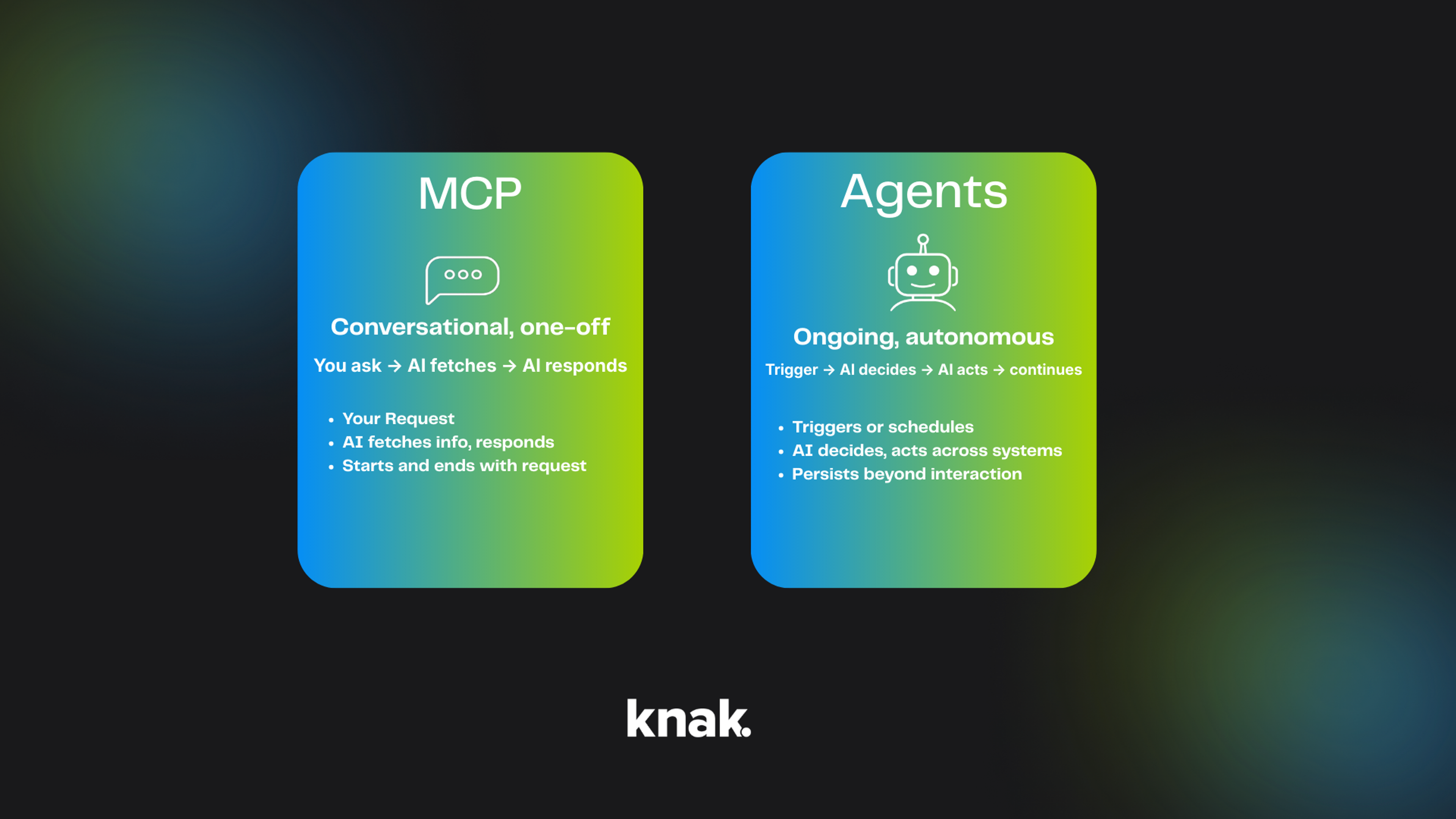
"MCP gets mentioned alongside agents a lot, but it solves a different problem," she explains. "The flow usually looks like this: you ask for something, the AI pulls data, summarizes it, or triggers an action, the task finishes, and that's it. MCP does not keep running in the background. There's no persistence."
This distinction helps clarify where MCP adds value:
MCP is for conversational, one-off actions. You're in Claude or ChatGPT, you need information from your systems, MCP enables the AI to fetch it and respond. The interaction starts and ends with your request.
Agents are for ongoing, autonomous work. They run continuously, start from triggers or schedules, and make decisions across multiple systems. They persist beyond any single interaction.
Both have their place in marketing operations. MCP is what you use when you're actively working with an AI assistant and need it to access your tools. Agents are what you deploy when you want processes to run without constant human involvement.
"Use MCP when you're already in ChatGPT, Claude, or Cursor and need a fast answer or action right now," Miranda advises. Her example: "You're at a conference, you snap a photo of someone's badge and ask 'Is she a customer?' MCP checks your systems, pulls the right data, and returns a clear summary of who she is, her account status, and how she's using your product."
That's a compelling use case for any marketer who's stood at a conference booth wondering if the person approaching is a prospect or an existing customer.
Why marketing ops should care about MCPs
Drew Price, Growth and Marketing Operations leader, frames the significance directly: "Marketing Ops should absolutely care about the rise of MCPs because they fundamentally shorten the distance between insight and action."
The operational implications are substantial. Today, getting AI to work with your brand context typically means one of two approaches: either you paste relevant information into each prompt (tedious, inconsistent), or you invest in a platform that has pre-built integrations with your specific tools (expensive, vendor lock-in).
MCP offers a third path. As the protocol gains adoption, AI tools that implement MCP will be able to connect to any MCP-enabled data source. Your brand guidelines in your DAM become accessible to your AI writing assistant. Your campaign history in your MAP becomes context for performance recommendations. Your customer data in your CRM becomes available for personalization suggestions.
For marketing teams already struggling with tool fragmentation, this matters. 61% of marketing ops professionals cite organizational silos as the primary barrier to strategic impact. MCP doesn't eliminate silos, but it creates a standardized way for AI to bridge them. It becomes infrastructure for the content supply chain.
The practical benefits for marketing operations:
Brand consistency at scale. AI that can actually check your style guide before generating content produces more consistent output. The gap between "AI draft" and "usable draft" shrinks when the AI has context. This is especially valuable for dynamic content that adapts to different segments.
Reduced integration complexity. Instead of evaluating whether each AI tool integrates with your specific stack, MCP-enabled tools work with any MCP-enabled data source. The integration matrix simplifies.
Context that travels. When you switch between AI tools, MCP means your brand context can follow. You're not re-explaining your company to each new assistant.
Adopting MCP responsibly
Price brings a critical perspective to MCP adoption: the same capabilities that make it powerful also increase risk.
"We're moving beyond AI as a helper into agentic systems that can observe data, make decisions, and execute changes across production tools," he observes. "That shift is powerful, and it dramatically increases risk if not handled thoughtfully."
His mental model is clarifying: "AI agents should be treated more like junior employees with elevated access than traditional software features. They need clearer scopes, stricter permissions, and better monitoring than we've historically applied to humans."
When evaluating MCP implementations or AI-powered vendors, Price anchors on three guardrails:
Scope: Constrain power by default
Agents should have the smallest possible surface area required to be useful.
What this means practically:
- Fine-grained permissions (read vs write, production vs sandbox)
- Clear separation between recommendation and execution
- Explicit boundaries on which systems and actions an agent can touch
"If an agent can take action, Marketing Ops should be able to answer: what exactly can it change, and what can it never change?" Price notes.
This principle applies directly to MCP implementations. When an AI assistant connects to your CRM via MCP, what permissions does it have? Can it read customer records? Update them? Delete them? The protocol enables connection; your governance determines what that connection can do.
Visibility: Assume mistakes will happen
Agentic systems will fail at some point. The question is whether you'll see it in time.
Price looks for:
- Full audit logs of agent actions
- Human-readable decision traces or reasoning
- Alerting when behavior deviates from expected patterns
"This mirrors how we already manage deliverability, data quality, or IP warm-ups," he explains. "Monitor first, trust later."
For marketing teams evaluating MCP-enabled tools, this translates to specific questions: Can you see what the AI accessed? Can you trace why it made specific recommendations? Do you get alerts when it does something unexpected?
Reversibility: No irreversible actions without humans
Speed is valuable, but recoverability matters more.
Non-negotiables according to Price:
- Kill switches
- Rollback mechanisms
- Human approval for high-impact or destructive actions
"If an AI system can't be safely stopped or undone, it shouldn't have production access."
This guardrail is particularly relevant as MCP matures. Early implementations will likely be read-only, letting AI access your data without changing it. As the technology evolves and write access becomes more common, reversibility becomes critical. An AI that can update your CRM records needs to be stoppable if it starts updating them incorrectly.
Security questions to ask AI vendors
Price has developed a set of questions specifically for evaluating AI vendors in the context of MCP and agentic capabilities. Most security checklists weren't designed for this new category of tools, so he focuses on operational clarity over buzzwords.
Questions that matter:
Data handling
- What data is stored vs processed transiently?
- Is customer data isolated from model training?
- How are credentials stored, rotated, and scoped?
Auditability
- Can every agent action be audited end-to-end?
- Is there human-readable logging of AI decisions?
Multi-tenancy
- What protections exist against cross-tenant data leakage?
- How is your data separated from other customers?
"If a vendor can't explain these answers clearly to a marketing ops audience, that's a signal, not a footnote," Price advises.
These questions become more important as MCP adoption increases. When AI tools can access your brand data, customer information, and campaign history, understanding exactly how that access is governed moves from nice-to-have to essential.
AI is already reading your emails
While MCP connects AI to your systems, AI is simultaneously connecting to your audience's inboxes. Email clients are already using AI to summarize, prioritize, and surface marketing emails, and this has practical implications for how you build.
Jay Oram, Head of Code and Solutions at ActionRocket, sees this as an extension of existing best practices rather than a new burden. "If you are following the best practices for deliverability and accessibility — live text over all images and sending relevant content — you are 90% of the way there," he says. "Something that may be new is how you write for email specifically, more cues from SEO and a little bit of prompt engineering to help AI tools get the information they need."
The practical details matter. Oram's team has found that AI assistants cannot read text embedded in images or access alt text. iOS Mail's AI summary takes into account the subject line and preview text first, then looks at the email content to see if it aligns. Whole-email AI summaries have more space but still depend on accessible, live text.
ActionRocket discovered a technique that significantly improves AI summary accuracy: adding an explicit AI summary in the hidden preview text element, after the standard whitespace hack. "This increased all of the AI summaries' accuracy to 95%, based on major elements in the email being summarized correctly, such as deal amounts, specific percentage offers, or other details," Oram reports.
The risk of ignoring this is real. "The smallest impact may see your emails not being summarized correctly," Oram warns. "The largest could be a whole email AI summary misguiding your recipients with an offer that doesn't exist, or upsetting them enough that they unsubscribe or worse, mark as spam."
This connects directly to MCP's promise. As AI inboxes get smarter about reading and prioritizing emails, the brands building content that AI can accurately interpret will have an advantage. The same principles that make content MCP-ready — structured, contextual, machine-readable — make emails AI-inbox-ready.
The current state of MCP adoption
MCP is early. Very early. Anthropic released the specification in late 2024, and adoption is still ramping up. Most marketing teams won't encounter MCP directly for months or years.
But the direction is clear. The protocol has been adopted by enterprise integration platforms. AI assistants are adding MCP support. The infrastructure is being built.
For marketing operations leaders, the current moment is about awareness rather than implementation. Understanding what MCP enables helps you:
Evaluate vendor claims. When an AI vendor talks about "connecting to your brand context" or "integrating with your stack," you can ask whether they're using MCP or proprietary integrations. The answer affects your flexibility and vendor lock-in.
Plan infrastructure investments. As you evaluate DAMs, CMSs, and other platforms, MCP compatibility becomes a consideration. Tools that implement MCP will be easier to connect to future AI capabilities.
Set governance now. The guardrails Price describes aren't theoretical. They're the policies you'll need when AI tools start connecting to your production systems. Building that governance muscle now prepares you for adoption later.
What MCP means for enterprise marketing
The promise of MCP for enterprise marketing is straightforward: AI that actually understands your brand.
Current AI tools are impressive at generating content, but they're working with generic knowledge. They don't know your voice, your positioning, your approved terminology, your visual standards. Every prompt requires context that should already exist somewhere in your systems.
MCP creates the plumbing for AI to access that context directly. Your brand guidelines become queryable. Your campaign history becomes referenceable. Your asset library becomes accessible. The design-to-deployment workflow that enterprise teams already use becomes AI-enabled.
The result is AI assistance that's actually useful for enterprise marketing, not generic content that requires extensive editing, but contextually aware suggestions that reflect your specific brand and history.
73% of marketing ops professionals are already using, testing, or experimenting with AI tools. Most are working around the context limitation through careful prompting, copied-and-pasted style guides, and extensive human review. MCP offers a more sustainable path: AI that can access your brand context without you having to explain it every time.
The technology is early. The implications are significant. Marketing operations leaders who understand MCP now will be better positioned to evaluate tools, set governance, and adopt capabilities as they mature.
Enterprise AI in marketing isn't just about generating content faster. It's about generating content that actually sounds like your brand. MCP is the infrastructure that makes that possible.